

What is the Buyers Guide?
The Used Car Rule does two things. It names the acts the FTC treats as deceptive or unfair when a Dealer sells a used vehicle, and then it gives you a way to stay clear of them: fill out and display the Buyers Guide. The rule says so directly. Comply with the form sections and you do not violate the rule; skip them and you do.
What the rule treats as a violation
- Misrepresenting the mechanical condition of a used vehicle
- Misrepresenting the terms of any warranty offered with the sale
- Representing that a used vehicle is sold with a warranty when it is sold without one
- Failing to disclose, before the sale, that a used vehicle is sold without any warranty
- Failing to make the terms of a written warranty available before the sale
Agency· 16 CFR §455.1(a) — General duties of a used vehicle dealer
"It is a deceptive act or practice for any used vehicle dealer, when that dealer sells or offers for sale a used vehicle in or affecting commerce … (1) To misrepresent the mechanical condition of a used vehicle; (2) To misrepresent the terms of any warranty offered in connection with the sale of a used vehicle; and (3) To represent that a used vehicle is sold with a warranty when the vehicle is sold without any warranty."
16 CFR §455.1(a)
Agency· 16 CFR §455.1(c) — General duties of a used vehicle dealer
"It is a violation of this Rule for any used vehicle dealer to fail to comply with the requirements set forth in §§ 455.2 through 455.5 of this part. If a used vehicle dealer complies with the requirements of §§ 455.2 through 455.5 of this part, the dealer does not violate this Rule."
16 CFR §455.1(c)
Who must display it
The rule applies to any Dealer who sells, or offers for sale, more than five used vehicles in a 12-month period. The test is volume, not licensing.
Agency· FTC Used Car Rule Guide
“In fact, car dealers who sell, or offer for sale, more than five used vehicles in a 12-month period must comply with the Rule.”
FTC Used Car Rule Guide
Agency· 16 CFR §455.1(d)(3) — Definitions — dealer
"Dealer means any person or business which sells or offers for sale a used vehicle after selling or offering for sale five (5) or more used vehicles in the previous twelve months, but does not include a bank or financial institution, a business selling a used vehicle to an employee of that business, or a lessor selling a leased vehicle by or to that vehicle's lessee or to an employee of the lessee."
16 CFR §455.1(d)(3)
When is a Buyers Guide not required
The Buyers Guide requirement applies only to Dealers offering vehicles to consumers. It does not reach anyone who is not a used vehicle Dealer, and a wholesale sale from one Dealer to another is outside it. The rule also writes three sellers out of the definition by name: banks and financial institutions, a business selling a used vehicle to its own employee, and a lessor selling a leased vehicle to that vehicle’s lessee or their employee.
Download the Buyers Guide
The FTC publishes the Buyers Guide as a free form. Print it on your own stock — there is no charge and no order process.
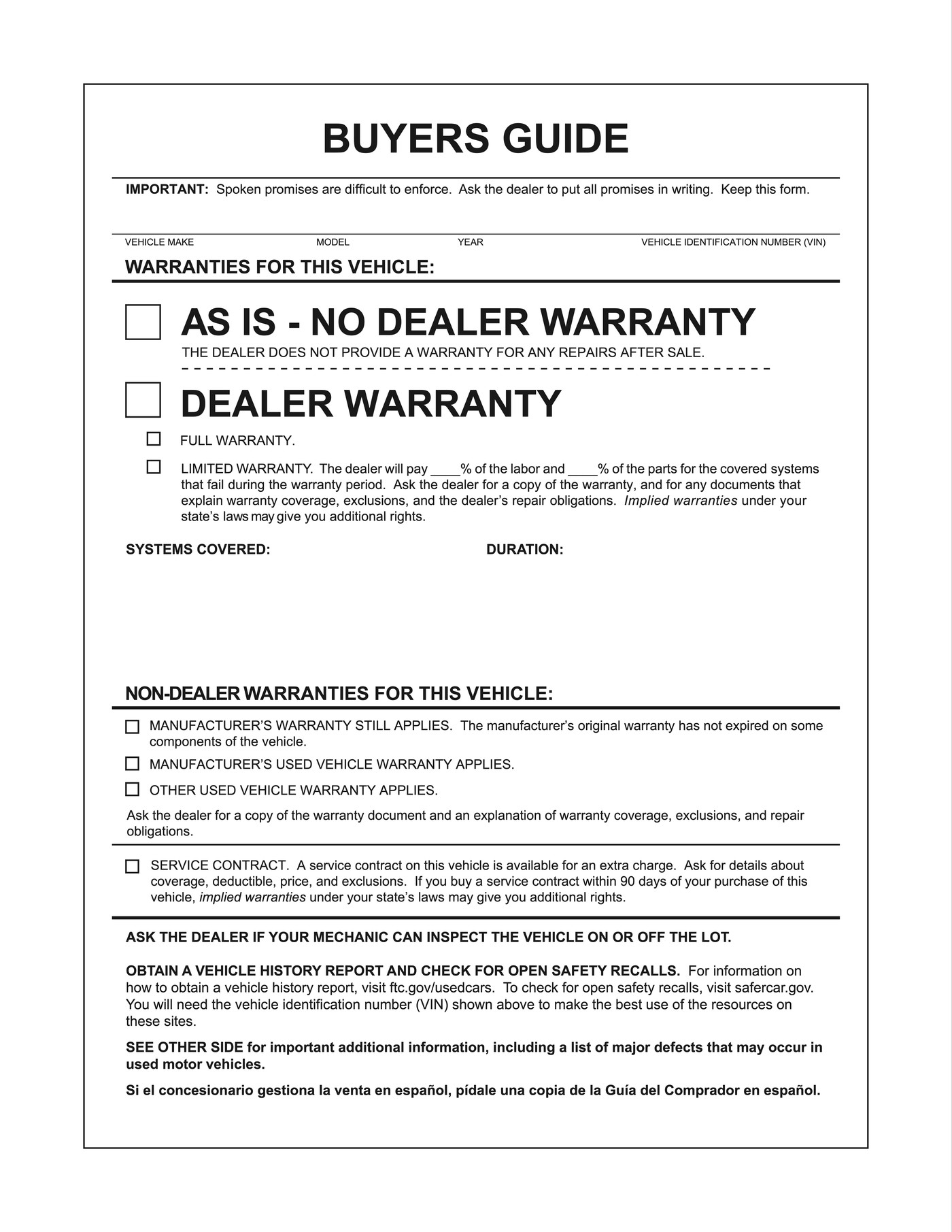
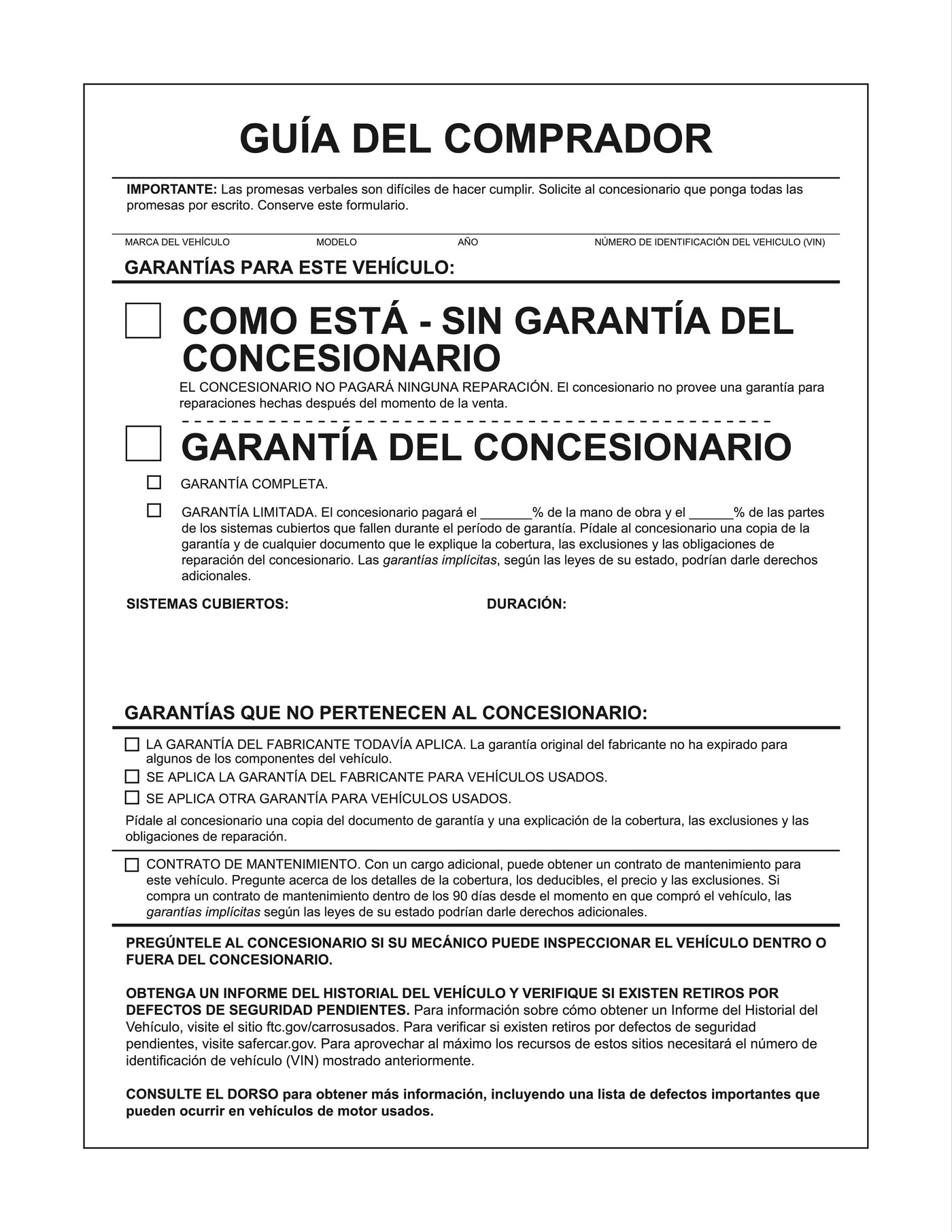
Print the Spanish version whenever you conduct the sale in Spanish. The printing rules below apply to both.
How to fill out the Buyers Guide
Every blank on the form is spelled out in the regulation. Work through them in this order and the form will be complete before the vehicle goes out on the lot.
1. Choose which version of the form to print
The Buyers Guide PDF comes in two versions, available in English and Spanish — and the two versions look nearly identical. Only the no-warranty heading in the top-left corner differs, so confirm which one applies before you print a stack.
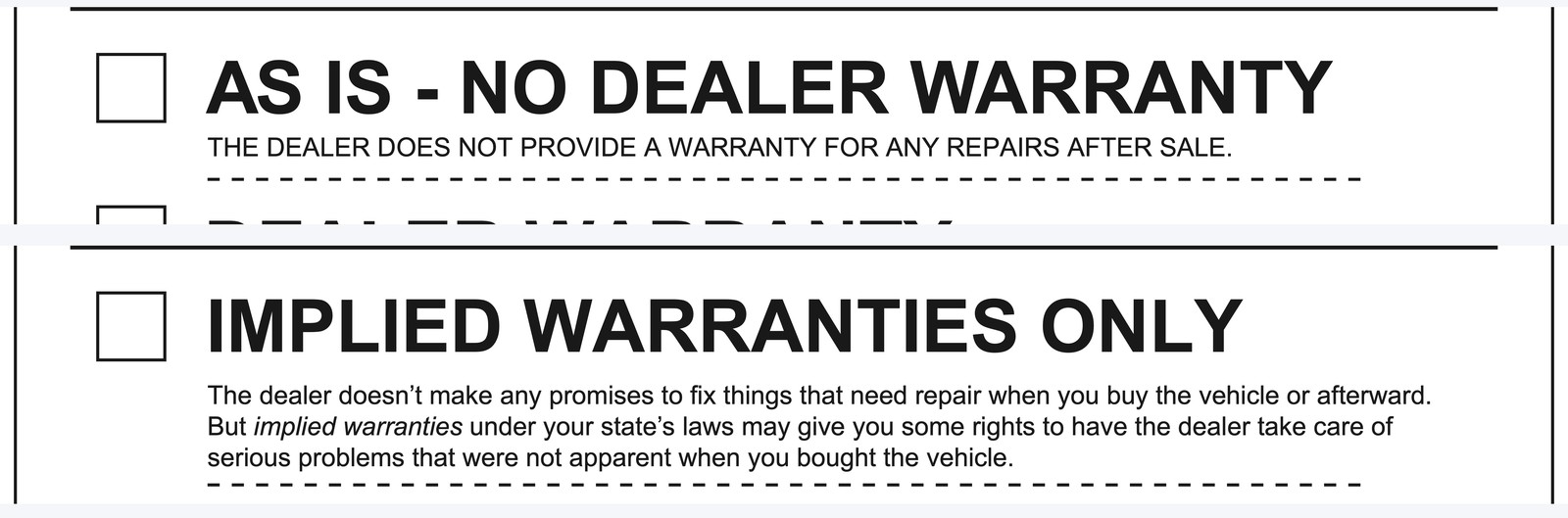
The two versions
- AS IS — NO DEALER WARRANTY: used where state law lets a Dealer disclaim the implied warranties.
- IMPLIED WARRANTIES ONLY: used in states that limit or prohibit as-is vehicle sales.
Both carry the same DEALER WARRANTY section, so either version works for a vehicle you are warranting. The version only matters when you are not giving a warranty.
Confirm which version applies in your state
This turns on whether your state lets a Dealer disclaim implied warranties on a used vehicle. Get that confirmed before you print.
2. Fill in the vehicle information
The top box identifies the exact vehicle. Every field except the stock number is required.

What goes in the box
- Make — the manufacturer, such as Chevrolet.
- Model — such as Corvette.
- Model year
- Vehicle identification number (VIN) — the full VIN, not a partial.
- Dealer stock number — optional. Leave it blank if you do not use stock numbers.
3. Indicate if the vehicle is covered by a warranty
Step 1 decided which version you printed. This step is about this particular vehicle: are you selling it with a Dealer warranty, or without one?
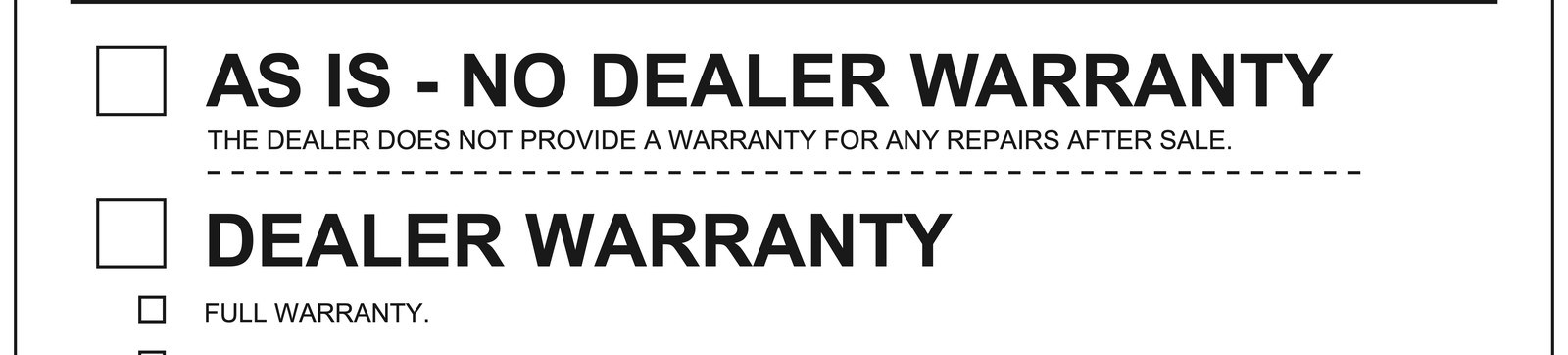
Check exactly one
- The no-warranty heading — whichever one your version prints, As Is or Implied Warranties Only.
- DEALER WARRANTY — you are giving a warranty, and step 4 defines its terms.
Never check both, and never leave both blank. A Guide with no box checked does not disclose anything.
4. If you check Dealer Warranty, fill in the coverage
Checking the box is not enough. The form has fields underneath it that define exactly what you are promising, and leaving any of them blank leaves the warranty undefined.
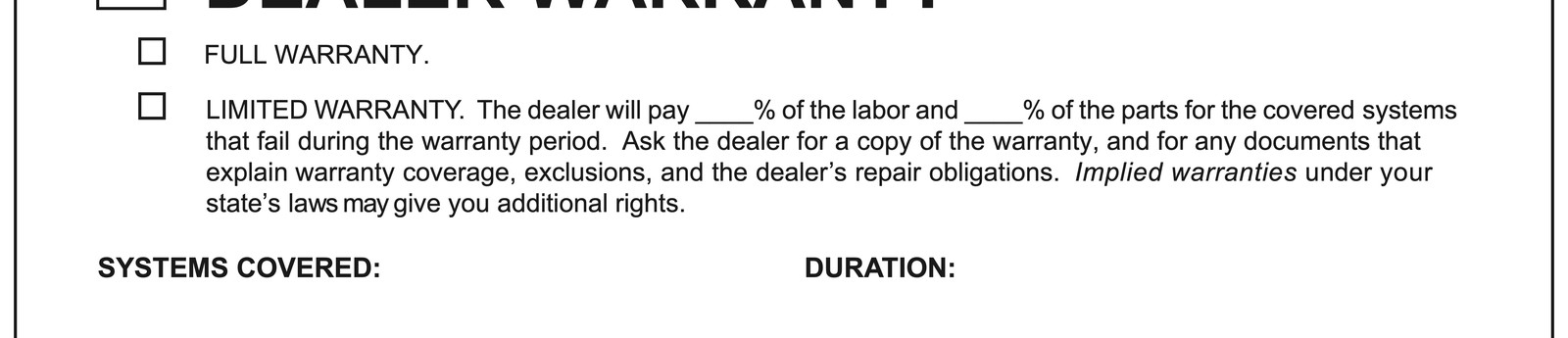
What you must complete
- Full or Limited: check one of the two sub-boxes under Dealer Warranty.
- The percentages: the Dealer will pay ___% of the labor and ___% of the parts.
- SYSTEMS COVERED: write in exactly which systems the warranty covers.
- DURATION: write in how long the coverage lasts.
Avoid warranty disputes by detailing the coverage limits. “Engine and transmission, 30 days or 1,000 miles, 50% parts and 50% labor” is enforceable. A checked box with blank fields is not.
5. Mark any non-dealer warranties and the service contract box
These boxes tell the buyer that someone other than you may still be on the hook, and whether a service contract is on the table. Check only what actually applies.
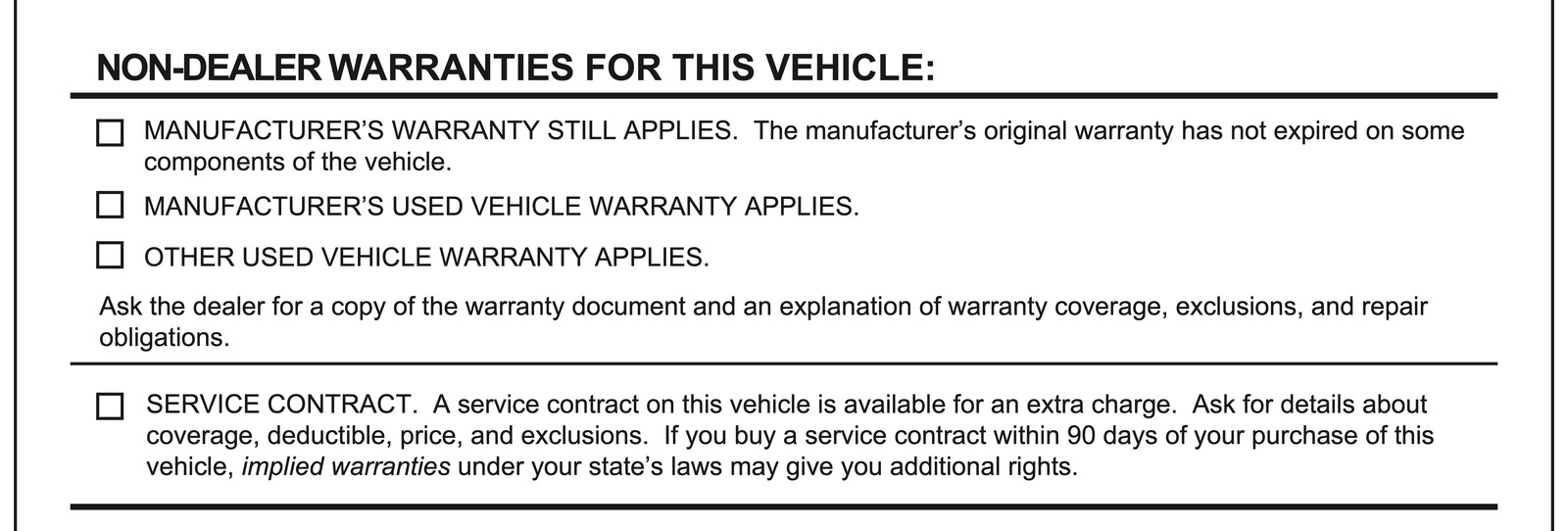
Non-dealer warranties — check any that apply
- MANUFACTURER'S WARRANTY STILL APPLIES — the original factory warranty has not expired.
- MANUFACTURER'S USED VEHICLE WARRANTY APPLIES — a manufacturer-backed certified or used-vehicle program covers it.
- OTHER USED VEHICLE WARRANTY APPLIES — a third-party warranty covers it.
Service contract
- SERVICE CONTRACT — check this if a service contract is available on this vehicle for an extra charge.
A service contract is not a warranty. Checking this box does not give the buyer any coverage from you — it only tells them one is offered for sale.
6. Fill in your dealership details and complaint contact
The bottom of the form identifies you and tells the buyer who to call if something goes wrong after the sale.
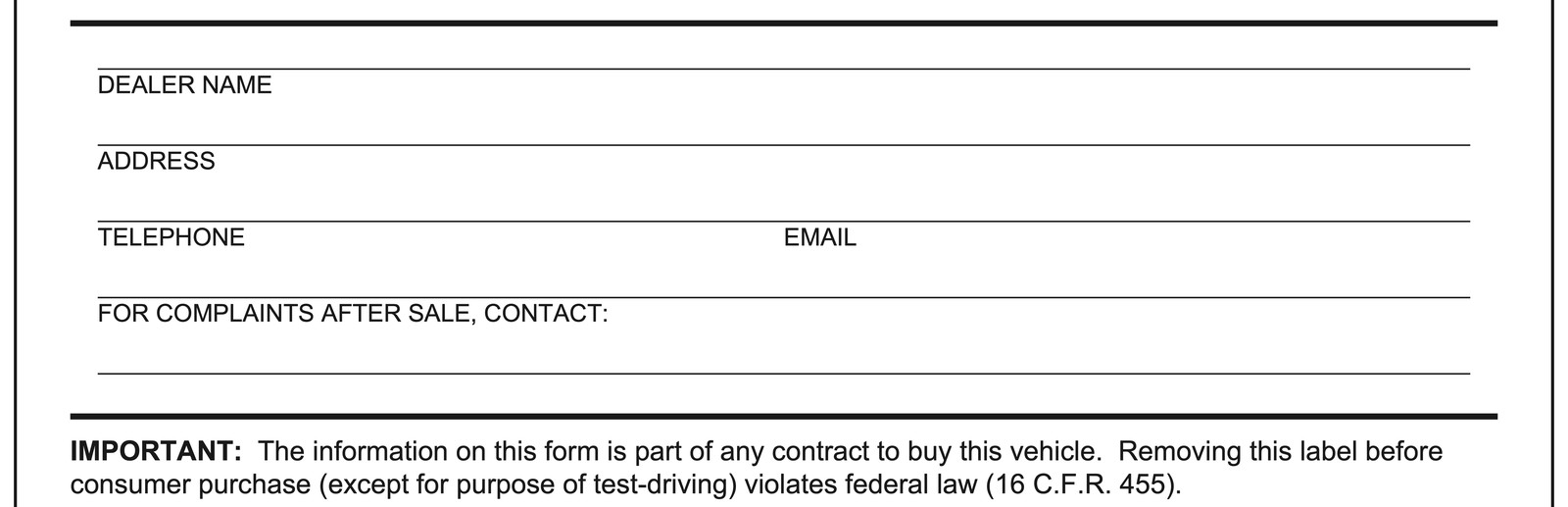
What goes at the bottom
- Dealer name
- Address
- Telephone number
- Email address
- Complaint contact — the name or position of the person a buyer should see, and how to reach them.
Name a real position, not just the dealership. “Sales manager” with a direct line is useful. A main switchboard number is not.
7. Add the optional signature line
You may add a line for the buyer to sign acknowledging receipt of the Guide. It is optional, but if you use it, the rule dictates both the wording next to it and where on the form it goes.
What the signature line requires
- The disclosure has to sit in immediate proximity to the signature line
- It has to read: "I hereby acknowledge receipt of the Buyers Guide at the closing of this sale."
- It goes in the space provided for the name of the person to be contacted about complaints after the sale
- You may preprint the language on the form
Agency· 16 CFR §455.2(f) — Consumer sales — window form
"In the space provided for the name of the individual to be contacted in the event of complaints after sale, you may include a signature line for a buyer's signature. If you opt to include a signature line, you must include a disclosure in immediate proximity to the signature line stating: 'I hereby acknowledge receipt of the Buyers Guide at the closing of this sale.' You may pre-print this language on the form if you choose."
16 CFR §455.2(f)
8. Update the form if the warranty changes during negotiation
Warranty terms are negotiable, and the form has to end up matching what you agreed to. When coverage changes at the desk, you mark the change on the Guide rather than printing a clean one that hides the original offer.
How to handle a change
- If you and the buyer agree to changes in the warranty coverage, mark the changes on the form
- If you first offered the vehicle with a warranty but sell it without one, cross out the offered warranty and mark either the "As Is — No Dealer Warranty" box or the "Implied Warranties Only" box
- If you first offered it "as is" or with implied warranties only but then sell it with a warranty, cross out that disclosure and fill in the warranty terms
Agency· 16 CFR §455.2(b)(2) — Consumer sales — window form
"If, following negotiations, you and the buyer agree to changes in the warranty coverage, mark the changes on the form, as appropriate. If you first offer the vehicle with a warranty, but then sell it without one, cross out the offered warranty and mark either the 'As Is—No Dealer Warranty' box or the 'Implied Warranties Only' box, as appropriate."
16 CFR §455.2(b)(2)
What counts as a used vehicle?
"Used vehicle" has a specific federal meaning here, and it is narrower than the everyday sense of the phrase. The rule sets size and weight limits on what counts as a vehicle at all, then defines a used one by how far it has been driven rather than by whether it was ever titled.
The size, weight, and mileage tests
A vehicle is inside the rule only if it clears three physical limits and is not a motorcycle. It becomes a used vehicle the moment it has been driven beyond what is needed to move it or road test it before delivery, which is why demonstrators and program vehicles are covered even though they were never sold to a retail buyer.
What is covered
- Any motorized vehicle other than a motorcycle with a gross vehicle weight rating under 8,500 pounds, a curb weight under 6,000 pounds, and a frontal area under 46 square feet
- Any such vehicle driven more than the limited use needed to move or road test it before delivery
- Light-duty vans, light-duty trucks, demonstrators, and program vehicles that meet those specifications, whether or not the vehicle was previously titled
Agency· 16 CFR §455.1(d)(1) — Definitions — vehicle
"Vehicle means any motorized vehicle, other than a motorcycle, with a gross vehicle weight rating (GVWR) of less than 8500 lbs., a curb weight of less than 6,000 lbs., and a frontal area of less than 46 sq. ft."
16 CFR §455.1(d)(1)
Agency· 16 CFR §455.1(d)(2) — Definitions — used vehicle
"Used vehicle means any vehicle driven more than the limited use necessary in moving or road testing a new vehicle prior to delivery to a consumer, but does not include any vehicle sold only for scrap or parts (title documents surrendered to the State and a salvage certificate issued)."
16 CFR §455.1(d)(2)
What the rule leaves out
Four categories fall outside the rule entirely. Three of them come from the regulation's own definitions, and the FTC adds agricultural equipment in its guidance for Dealers.
Not covered by the Used Car Rule
- Motorcycles
- Any vehicle sold only for scrap or parts, where the title documents are surrendered to the state and a salvage certificate is issued
- Anything at or above 8,500 pounds GVWR, 6,000 pounds curb weight, or 46 square feet of frontal area
- Agricultural equipment, per the FTC's Dealer guidance
Agency· FTC Used Car Rule Guide
"Exceptions to the Rule are: motorcycles; any vehicle sold for scrap or parts if the dealer submits title documents to the appropriate state authority and obtains a salvage certification; and agricultural equipment."
FTC Used Car Rule Guide
When and where to display the Buyers Guide
Timing is the part dealers most often get wrong. The Guide has to be on the vehicle before the vehicle is offered, not at the point a customer starts writing a deal, and it has to be visible from both sides while it hangs there.
Post it before you offer the vehicle for sale
The duty attaches before the vehicle goes out for sale. That includes a vehicle that is not yet detailed, reconditioned, or otherwise ready for delivery, and it includes letting a customer inspect the vehicle with an eye toward buying it. If a consumer can look at it as merchandise, the Guide belongs on it.
When the Guide must already be posted
- Before you display the vehicle for sale
- Before you let a customer inspect it for the purpose of buying it
- Even when the vehicle is not fully prepared for delivery
- On consigned vehicles, and on vehicles you hold under power of attorney or another agreement
Agency· 16 CFR §455.2(a) — Consumer sales — window form
"Before you offer a used vehicle for sale to a consumer, you must prepare, fill in as applicable and display on that vehicle the applicable 'Buyers Guide' illustrated by Figures 1-2 at the end of this part."
16 CFR §455.2(a)
Agency· FTC Used Car Rule Guide
"You must post a Buyers Guide before you display a vehicle for sale or let a customer inspect it for the purpose of buying it, even if the car is not fully prepared for delivery."
FTC Used Car Rule Guide
Hang it so both sides can be read
The regulation lets you put the form anywhere on the vehicle, as long as it is prominent, conspicuous, and readable front and back. The FTC's guidance gives the practical version: rear-view mirror, side-view mirror, under a wiper, or taped to a side window all work. Out of sight does not count as conspicuous.
Where the form can go
- Hanging from the rear-view mirror inside the vehicle
- Hanging from a side-view mirror outside the vehicle
- Under a windshield wiper
- Attached to a side window
- Not in the glove compartment, the trunk, or under a seat, because none of those is in plain sight
Note: You may take the Guide off the vehicle for a test drive, but it has to go back on the moment the test drive ends.
Agency· 16 CFR §455.2(a)(1) — Consumer sales — window form
"The Buyers Guide shall be displayed prominently and conspicuously in any location on a vehicle and in such a fashion that both sides are readily readable. You may remove the form temporarily from the vehicle during any test drive, but you must return it as soon as the test drive is over."
16 CFR §455.2(a)(1)
The two versions: As Is and Warranty
The rule illustrates two versions of the form, and which one you print depends on your state's law about selling without implied warranties. Figure 1 is the "As Is" version. Figure 2 replaces the "As Is" heading and paragraph with an "Implied Warranties Only" disclosure, for states that limit or prohibit "as is" vehicle sales. Both versions carry the same "Warranty" section, so either one can be used for a warranted vehicle.
The version depends on your state, not on the deal
This is the part Dealers get twisted. You do not pick a different form because you are adding a warranty or selling a service contract. In California, which uses the “As Is” version, that one form already carries a box for every situation — as is with no Dealer warranty, a Dealer warranty whether full or limited, a non-Dealer warranty, and a service contract. You tick what applies to the vehicle in front of you.
The "As Is — No Dealer Warranty" version
If your state allows it and you are selling the vehicle with no warranty at all, written or implied, you use the Figure 1 form and check the box next to "As Is — No Dealer Warranty." That is the version most Dealers in most states use on most of their inventory.
When to use it
Use the "As Is — No Dealer Warranty" version when state law permits an "as is" vehicle sale and you are offering the vehicle without any implied warranty and without a written warranty.
Agency· 16 CFR §455.2(b)(1)(i) — Consumer sales — window form
"If you offer the vehicle without any implied warranty, i.e., 'as is,' mark the box appearing in Figure 1."
16 CFR §455.2(b)(1)(i)
The "Implied Warranties Only" version
Some states limit or prohibit "as is" vehicle sales. In those states the federal rule steps back: the "As Is — No Dealer Warranty" heading and the paragraph under it must be deleted from the form and replaced with the "Implied Warranties Only" language the regulation prints out word for word. You also use this version by choice, in a state that allows "as is," if you decide to offer implied warranties only.
What the substituted disclosure says
The regulation supplies the exact replacement text, which reads: "IMPLIED WARRANTIES ONLY — The dealer doesn't make any promises to fix things that need repair when you buy the vehicle or afterward. But implied warranties under your state's laws may give you some rights to have the dealer take care of serious problems that were not apparent when you bought the vehicle."
Agency· 16 CFR §455.2(b)(1)(ii) — Consumer sales — window form
"If your State law limits or prohibits 'as is' sales of vehicles, that State law overrides this part and this rule does not give you the right to sell 'as is.' In such States, the heading 'As Is—No Dealer Warranty' and the paragraph immediately accompanying that phrase must be deleted from the form, and the following heading and paragraph must be substituted as illustrated in the Buyers Guide in Figure 2."
16 CFR §455.2(b)(1)(ii)
The Warranty section on either version
If you are selling the vehicle with a warranty you provide, you check the "Warranty" box instead and describe the coverage in the space provided. The regulation lists four pieces of information that description has to contain, and it bans shorthand: you cannot write "drive train" or "power train," you have to name the systems.
What the warranty description must include
- Whether the warranty is "Full" or "Limited," with the matching box marked
- Which specific systems are covered, for example "engine, transmission, differential"
- The duration, for example "30 days or 1,000 miles, whichever occurs first"
- The percentage of the repair cost you pay, for example "The dealer will pay 100% of the labor and 100% of the parts"
Note: A "Full" warranty is defined by the federal minimum standards in section 104 of the Magnuson-Moss Act, 15 U.S.C. 2304. The Magnuson-Moss Act does not apply to vehicles manufactured before July 4, 1975, so for those vehicles you may cross out both "Full" and "Limited" and leave only "Warranty."
Agency· 16 CFR §455.2(b)(2) — Consumer sales — window form
"If you offer the vehicle with a warranty, briefly describe the warranty terms in the space provided." … "Which of the specific systems are covered (for example, 'engine, transmission, differential'). You cannot use shorthand, such as 'drive train' or 'power train' for covered systems."
16 CFR §455.2(b)(2)
Non-dealer warranties are optional to disclose
You are allowed, but never required, to tell the buyer on the form that a warranty from somebody other than you still covers the vehicle. If you choose to, the form has three boxes for it under the heading "NON-DEALER WARRANTIES FOR THIS VEHICLE," and the regulation prints the wording of each.
The three non-dealer warranty boxes
- "MANUFACTURER'S WARRANTY STILL APPLIES. The manufacturer's original warranty has not expired on some components of the vehicle"
- "MANUFACTURER'S USED VEHICLE WARRANTY APPLIES"
- "OTHER USED VEHICLE WARRANTY APPLIES"
Note: If the buyer has to pay to get coverage under the manufacturer's warranty, the FTC treats that coverage as a service contract and you may not check the "Warranty" box for it.
Agency· 16 CFR §455.2(b)(2)(v) — Consumer sales — window form
"You may, but are not required to, disclose that a warranty from a source other than the dealer applies to the vehicle. If you choose to disclose the applicability of a non-dealer warranty, mark the applicable box or boxes beneath 'NON-DEALER WARRANTIES FOR THIS VEHICLE'…"
16 CFR §455.2(b)(2)(v)
Service contracts get their own added paragraph
If you make a service contract available on the vehicle, the rule requires you to add a specific heading and paragraph below the non-dealer warranties section and check the "Service Contract" box. The only exception is a state that regulates service contracts as the business of insurance, in which case the box is not required.
The paragraph the rule requires you to add
The regulation supplies it word for word: "SERVICE CONTRACT. A service contract on this vehicle is available for an extra charge. Ask for details about coverage, deductible, price, and exclusions. If you buy a service contract within 90 days of your purchase of this vehicle, implied warranties under your state's laws may give you additional rights."
Note: That 90-day reference is not decorative. Under the Magnuson-Moss Warranty Act, entering into a service contract with the buyer at the time of sale or within 90 days after it removes your ability to disclaim implied warranties on that vehicle.
Agency· 16 CFR §455.2(b)(3) — Consumer sales — window form
"If you make a service contract available on the vehicle, you must add the following heading and paragraph below the Non-Dealer Warranties Section and mark the box labeled 'Service Contract,' unless offering such service contract is 'the business of insurance' and such business is regulated by State law."
16 CFR §455.2(b)(3)
The law· 15 U.S.C. §2308(a) — Implied warranties
"No supplier may disclaim or modify (except as provided in subsection (b)) any implied warranty to a consumer with respect to such consumer product if (1) such supplier makes any written warranty to the consumer with respect to such consumer product, or (2) at the time of sale, or within 90 days thereafter, such supplier enters into a service contract with the consumer which applies to such consumer product."
15 U.S.C. §2308(a)
What is already printed on the form
You do not fill in the back. The Buyers Guide carries a pre-printed list of the major systems that can go wrong on a used vehicle, and a warning to get an independent inspection before you buy. It also points the buyer to check for open safety recalls and to get a vehicle history report. All of it is there for the buyer to read, not for you to complete.
The Buyers Guide printing rules are part of the law
The Buyers Guide is one of the few federal disclosures where the physical printing is regulated. You can generate the form yourself, but the wording, capitalization, punctuation, type styles, sizes, format, ink, paper, and dimensions are all fixed by the rule. Adding your dealership logo to the form is not allowed.
The printing requirements
- The capitalization, punctuation, and wording of every item, heading, and line of text must be exactly as the rule requires
- The entire form must be printed in 100% black ink
- It must be printed on white stock
- It must be no smaller than 11 inches high by 7 1/4 inches wide
- The type styles, sizes, and format must match what the rule indicates
- No other wording or symbols, including logos, may be placed on the form
- You may use colored ink to fill in the blanks
Agency· 16 CFR §455.2(a)(2) — Consumer sales — window form
"The capitalization, punctuation and wording of all items, headings, and text on the form must be exactly as required by this Rule. The entire form must be printed in 100% black ink on a white stock no smaller than 11 inches high by 7 1/4 inches wide in the type styles, sizes and format indicated."
16 CFR §455.2(a)(2)
Agency· FTC Used Car Rule Guide
"You can download the Buyers Guide from the FTC's Business Center, or you can get Buyers Guides from business-form companies or trade associations. You also can generate them yourself on a computer. However, you must use the wording, type style, type sizes, and format specified in the Rule. You are not allowed to place any other wording or symbols (including logos) on the Buyers Guide." … "These requirements cannot be modified in any way. You may use colored ink to fill in the blanks."
FTC Used Car Rule Guide
Agency· 16 CFR §455.2(a) — Consumer sales — window form
“Dealers may use remaining stocks of the version of the Buyers Guide in effect prior to the effective date of this Rule for up to one year after that effective date (i.e., until January 27, 2018).”
16 CFR §455.2(a)
Sales negotiated in Spanish need the Spanish Buyers Guide
If you conduct the sale in Spanish, the window form and the contract disclosures both have to be in Spanish. The regulation supplies the official Spanish layouts as Figures 4, 5, and 6, and prints the Spanish text of the "Implied Warranties Only" disclosure, the service contract paragraph, and the optional signature line. You are allowed to hang both the English form and the Spanish translation on the same vehicle.
What a Spanish-language sale requires
- The window form required by §455.2 must be in Spanish
- The contract disclosures required by §455.3 must be in Spanish
- Use the translation and layout in Figures 4, 5, and 6 of the rule
- You may display both an English window form and a Spanish translation on the vehicle
- The Spanish signature-line acknowledgment reads: "Por este medio confirmo que he recibido copia de la Guía del Comprador al momento de la compraventa."
Note: The FTC's guidance says the Spanish Buyers Guide has to be posted on the vehicle before you display or offer it for sale, not produced later when a Spanish-speaking customer arrives.
Agency· 16 CFR §455.5(a) — Spanish language sales
"If you conduct a sale in Spanish, the window form required by § 455.2 and the contract disclosures required by § 455.3 must be in that language. You may display on a vehicle both an English language window form and a Spanish language translation of that form. Use the translation and layout for Spanish language sales in Figures 4, 5, and 6."
16 CFR §455.5(a)
What you must give the buyer at the sale
Displaying the Guide is only half of the duty. When the deal closes, the form has to change hands, and a specific sentence has to appear in the contract.
Give the buyer the final window form
The buyer leaves with the window form that was displayed on the vehicle, or a copy of it, and that document has to carry all the required disclosures and reflect the warranty coverage you actually agreed to. If you used a signature line, the copy the buyer signs has to be the one showing the final changes.
The buyer leaves with the final form
- Give the buyer the displayed window form, or a copy that accurately reflects every required disclosure
- The document has to show the final, negotiated warranty coverage, not the original offer
- If you use a signature line, the buyer signs the version showing all final changes
Agency· 16 CFR §455.3(a) — Window form
"Give the buyer of a used vehicle sold by you the window form displayed under § 455.2 containing all of the disclosures required by the Rule and reflecting the warranty coverage agreed upon. If you prefer, you may give the buyer a copy of the original, so long as that copy accurately reflects all of the disclosures required by the Rule and the warranty coverage agreed upon."
16 CFR §455.3(a)
The window form becomes part of the contract
The information on the final window form is folded into the contract of sale by operation of the rule, and where the two disagree, the window form wins. Because of that, the rule requires you to tell the buyer so, in specific words, inside every consumer contract of sale.
The sentence that must appear in every contract of sale
The rule prints it word for word: "The information you see on the window form for this vehicle is part of this contract. Information on the window form overrides any contrary provisions in the contract of sale."
Note: The rule says this language has to appear conspicuously in each consumer contract of sale. Burying it in fine print does not satisfy the requirement.
Agency· 16 CFR §455.3(b) — Window form
"The information on the final version of the window form is incorporated into the contract of sale for each used vehicle you sell to a consumer. Information on the window form overrides any contrary provisions in the contract of sale. To inform the consumer of these facts, include the following language conspicuously in each consumer contract of sale…"
16 CFR §455.3(b)
Nothing you say may contradict the Guide
Once the disclosures are on the form, you cannot walk them back verbally or in another document. Negotiating warranty coverage is fine, but the final terms have to land in the contract of sale and be summarized on the copy of the window form the buyer takes home.
The Guide outranks anything you say
- No statement, oral or written, may alter or contradict the disclosures required by §455.2 and §455.3
- No other action may alter or contradict them either
- Warranty coverage may still be negotiated, as long as the final terms are identified in the contract of sale and summarized on the buyer's copy of the window form
Agency· 16 CFR §455.4 — Contrary statements
"You may not make any statements, oral or written, or take other actions which alter or contradict the disclosures required by §§ 455.2 and 455.3. You may negotiate over warranty coverage, as provided in § 455.2(b) of this part, as long as the final warranty terms are identified in the contract of sale and summarized on the copy of the window form you give to the buyer."
16 CFR §455.4
A violation can cost $53,088 per vehicle
The Used Car Rule is an FTC trade regulation rule, so violations are enforced through the FTC Act's civil penalty provisions, and those amounts are adjusted for inflation each year. As of the January 17, 2025 adjustment, the maximum is $53,088 per violation. The count runs per violation, which in practice means per vehicle.
What a violation exposes you to
- Up to $53,088 per violation in an FTC enforcement action
- Separate state or local enforcement, because many states have laws or regulations similar to the Used Car Rule
- Enforcement under your own state's law where the state incorporates the federal Used Car Rule by reference
Note: These maximums are normally adjusted for inflation each year. There was no adjustment for 2026, so $53,088 remains the amount in force. Check 16 CFR §1.98 for the figure at the time a penalty is assessed.
Agency· FTC Used Car Rule Guide
"Dealers who violate the Used Car Rule may be subject to penalties of up to $53,088 per violation in FTC enforcement actions. Many states have laws or regulations that are similar to the Used Car Rule. Some states incorporate the Used Car Rule by reference in their state laws. As a result, state and local law enforcement officials may have the authority to ensure that dealers post Buyers Guides and to fine them or sue them if they do not comply."
FTC Used Car Rule Guide
Agency· 16 CFR §1.98 — Adjustment of civil monetary penalty amounts
"Section 5(m)(1)(A) of the FTC Act, 15 U.S.C. 45(m)(1)(A) — $53,088" … "The following maximum civil penalty amounts apply only to penalties assessed after January 17, 2025, including those penalties whose associated violation predated January 17, 2025."
16 CFR §1.98
Sources
- 16 CFR Part 455 — the Used Car Rule
- 16 CFR §455.1 — General duties of a used vehicle Dealer; definitions
- 16 CFR §455.2 — Consumer sales, window form
- 16 CFR §455.3 — Window form given to buyer and incorporated into the contract
- 16 CFR §455.5 — Spanish language sales
- 16 CFR §1.98 — Adjustment of civil monetary penalty amounts
- FTC — Buyers Guide (official form)
- CIV §1792.4 — "as is" disclaimer requirements
- VEH §11713.18 — "certified" used vehicles
