

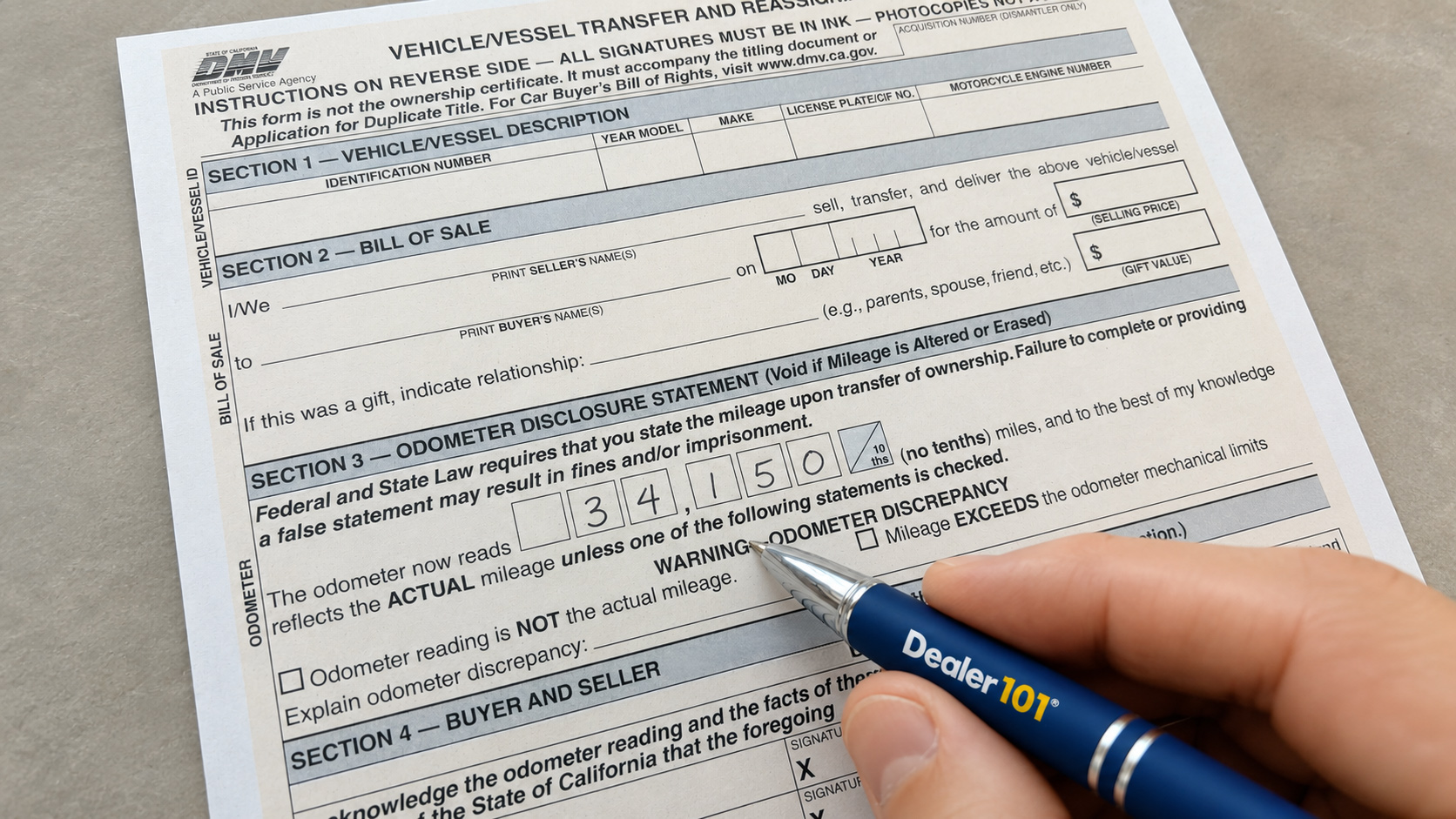
Everything on this page is federal law — it applies identically in every state. Your state adds its own paperwork and penalties on top; the state-by-state table below covers the paperwork.
What is an Odometer Disclosure?
An odometer disclosure is a signed written statement, made at the time you transfer ownership of a vehicle, that tells the buyer how many miles the odometer reads and whether that number is the vehicle's true mileage. It is a federal requirement, completed by the person transferring the vehicle — and because the requirement is federal, every state collects it. The rules on this page apply wherever you sell.
Put the mileage in writing, every transfer
- You state the mileage in writing when you transfer the vehicle.
- You also state whether that mileage is the actual mileage.
- If the odometer reading is not the actual mileage, federal law requires you to acknowledge that.
The law· 49 U.S.C. §32705(a)(1) — Disclosure requirements on transfer
"Under regulations prescribed by the Secretary of Transportation that include the way in which information is disclosed and retained under this section, a person transferring ownership of a motor vehicle shall give the transferee the following written disclosure: (A) Disclosure of the cumulative mileage registered on the odometer. (B) Disclosure that the actual mileage is unknown, if the transferor knows that the odometer reading is different from the number of miles the vehicle has actually traveled."
49 U.S.C. §32705(a)(1)
Why the requirement exists
The disclosure comes from the federal Truth in Mileage Act of 1986, which Congress added to the older federal odometer statute. Every state collects the disclosure on its registration and transfer paperwork specifically to comply with that federal act — which is why the same mileage boxes appear on titles from every state.
Federal regulation sets out every element a valid odometer disclosure has to carry. It is more than the number on the dash: the disclosure identifies the vehicle, both parties, the date, and it has to be signed by the transferor and acknowledged by the transferee. Miss one of these elements and the disclosure is incomplete.
Federal rule, collected on the title
Which vehicles are exempt from odometer disclosure
The exemptions are written into 49 CFR §580.17, which suspends the disclosure requirement of §580.5 for the vehicles listed. Two of them come up constantly on a used-car lot: heavy trucks and older vehicles.
No disclosure required for
| Vehicle or transfer | Exemption condition |
|---|---|
| Heavy vehicles | Gross Vehicle Weight Rating over 16,000 pounds |
| Not self-propelled | Trailers and similar towed equipment |
| Model year 2010 or older | Transferred at least 10 years after January 1 of its model year |
| Model year 2011 or newer | Transferred at least 20 years after January 1 of its model year |
| Government sales | Sold directly by the manufacturer to a U.S. government agency under contract |
| Pre-retail transfers | A new vehicle moved before its first transfer for a purpose other than resale |
The change took effect January 1, 2021. Model year 2010 vehicles reached their 10-year mark on January 1, 2020; model year 2011 vehicles are on the 20-year period and do not reach theirs until January 1, 2031.
Agency· 49 CFR §580.17 — Exemptions
"Notwithstanding the requirements of §§ 580.5 and 580.7: (a) A transferor or a lessee of any of the following motor vehicles need not disclose the vehicle's odometer mileage: (1) A vehicle having a Gross Vehicle Weight Rating, as defined in § 571.3 of this title, of more than 16,000 pounds; (2) A vehicle that is not self-propelled; (3)(i) A vehicle manufactured in or before the 2010 model year that is transferred at least 10 years after January 1 of the calendar year corresponding to its designated model year; … (4)(i) A vehicle manufactured in or after the 2011 model year that is transferred at least 20 years after January 1 of the calendar year corresponding to its designated model year; … (5) A vehicle sold directly by the manufacturer to any agency of the United States in conformity with contractual specifications. (b) A transferor of a new vehicle prior to its first transfer for purposes other than resale need not disclose the vehicle's odometer mileage."
49 CFR §580.17
How to complete an odometer disclosure
The disclosure itself is short. Six steps complete it under the federal rule — on the title when it has room, or on your state’s disclosure document when it doesn’t.
1. Identify the vehicle
Write in the vehicle's make, model, year, body type, and full vehicle identification number on the disclosure document.
2. Enter the odometer reading and the date
Write the reading exactly as it appears on the vehicle's odometer, in whole miles. Federal law says not to include tenths of a mile. Enter the date of transfer alongside it.
3. Check a box only if it applies
If the reading is the true mileage to the best of your knowledge, leave both boxes alone. Check "exceeds mechanical limits" if the odometer has rolled past its highest number. Check "not the actual mileage" if you know the reading does not reflect the true mileage. The buyer must be warned of this discrepancy.
4. Print and sign as the seller
Print your name and current address and sign. If you are signing for the dealership, the business name may be printed or computer-generated, but the authorized agent countersigns. In a narrow set of circumstances the seller may hand this job to someone else under a secure power of attorney — see below.
5. Have the buyer print, sign and take a copy
The buyer signs the disclosure to acknowledge the mileage, prints their name, and enters their current address. Under the federal rule, the signed copy goes back to you, the seller—and make photocopies so the buyer leaves with one too.
6. Submit the original with the transfer application
The original odometer disclosure goes to your state’s titling agency with the transfer paperwork. Keep your photocopy in your deal file. If anything on the disclosure was crossed out or altered, do not submit it — start a new odometer disclosure document.
What goes on the disclosure
The information every disclosure carries
The transferor makes the disclosure to the transferee on the title itself, or on the document being used to reassign the title. If the vehicle is titled in your name, the disclosure has to be made on the title, not on a reassignment document.
What the disclosure must show
- The odometer reading at the time of transfer — whole miles, no tenths
- The date of transfer
- The transferor's printed name and current address — the seller
- The transferee's printed name and current address — the buyer
- The identity of the vehicle — make, model, year, body type, and vehicle identification number
- The transferor's signature — where more than one person is a transferor, only one has to sign
Agency· 49 CFR §580.5(c) — Disclosure of odometer information
"In connection with the transfer of ownership of a motor vehicle, the transferor shall disclose the mileage to the transferee on the physical or electronic title or, except as noted below, on the physical document being used to reassign the title. In the case of a transferor in whose name the vehicle is titled, the transferor shall disclose the mileage on the electronic title or the physical title, and not on a reassignment document. This disclosure must be signed by the transferor and must contain the transferor's printed name. In connection with the transfer of ownership of a motor vehicle in which more than one person is a transferor, only one transferor need sign the disclosure. In addition to the signature of the transferor, the disclosure must contain the following information: (1) The odometer reading at the time of transfer (not to include tenths of miles); (2) The date of transfer; (3) The transferor's printed name and current address; (4) The transferee's printed name and current address; and (5) The identity of the vehicle, including its make, model, year, body type, and vehicle identification number."
49 CFR §580.5(c)
The federal warning statement on the form
Every complying title and complying form carries a printed warning that federal law requires the mileage statement and that lying on it can lead to fines or prison. You do not write this line, but you should know it is there, because it is the sentence a prosecutor points at when a disclosure turns out to be false.
The printed warning
Agency· 49 CFR §580.5(d) — Disclosure of odometer information
"In addition to the information provided under paragraph (c) of this section, the physical document shall provide a statement referencing federal law and stating failure to complete the disclosure or providing false information may result in fines and/or imprisonment. Reference may also be made to applicable law of the jurisdiction."
49 CFR §580.5(d)
The two check boxes, explained
The three mileage certifications
Beyond writing the number down, you have to certify what that number means. Federal law gives you exactly three choices, and two of them are the check boxes Dealers ask about most. The default is that the reading is the actual mileage; you check a box only when one of the two exceptions applies.
Your three options
- Actual mileage — you certify that, to the best of your knowledge, the reading reflects the actual mileage. Nothing is checked.
- Exceeds mechanical limits — you know the reading is in excess of the odometer's designed mechanical limit, so you include a statement that the mileage exceeds mechanical limits.
- Not the actual mileage — you know the reading is not a valid mileage display, or differs from the true mileage by more than calibration error, so you include a statement that the reading is not the actual mileage and should not be relied upon, along with a warning to the buyer that a discrepancy exists. The classic case is a replacement instrument cluster from a junkyard — the car has 160,000 miles, the donor cluster reads 90,000.
Agency· 49 CFR §580.5(e) — Disclosure of odometer information
"(1) The transferor shall certify that to the best of their knowledge the odometer reading reflects the actual mileage, or; (2) If the transferor knows that the odometer reading reflects the amount of mileage in excess of the designed mechanical odometer limit, they shall include a statement that the mileage exceeds mechanical limits; or (3) If the transferor knows that the odometer reading does not reflect a valid mileage display or differs from the mileage and that the difference is greater than that caused by odometer calibration error, they shall include a statement that the odometer reading does not reflect the actual mileage, and should not be relied upon. This statement shall also include a warning notice to alert the transferee that a discrepancy exists between the odometer reading and the actual mileage."
49 CFR §580.5(e)
"Exceeds mechanical limits" means the odometer rolled over
This box is for a mechanical odometer that ran out of digits. When an odometer reaches the highest number it can physically display, it starts renumbering from the bottom, so a car that has traveled 145,000 miles reads 45,000.
When you check it
- The odometer has hit its top number and started renumbering at "1."
- The number showing is accurate as far as it goes; it is simply short by one full rotation of the odometer.
"Not the actual mileage" means the number cannot be trusted
This box is for a reading you know does not reflect how far the vehicle has actually gone. The federal rule ties it to a reading that is not a valid mileage display or that differs from true mileage by more than calibration error.
When you check it
- The odometer is broken.
- The odometer has been replaced.
- The current owner is unsure of the true mileage.
The two boxes are not interchangeable. "Exceeds mechanical limits" says the reading is right but the odometer ran out of digits. "Not the actual mileage" says the reading itself cannot be relied on, and it requires the added warning to the buyer under 49 CFR §580.5(e)(3).
Signing and submitting the disclosure
The buyer has to sign it too
An odometer disclosure is not finished when the seller signs. The buyer signs the same statement to acknowledge the mileage and prints their name, and the signed copy comes back to you as the seller.
Signature rules
- The seller signs and prints their name; the buyer then signs and prints theirs.
- On a paper title, a signature means the person's name written personally, by hand. Federal law also recognises a secure electronic signature where the state runs an approved electronic title system.
- A business may show a handprinted, typewritten or computer-generated business name, but the authorized agent still countersigns personally.
- Where the title shows multiple owners, one seller signature and one buyer signature is enough.
- No one may sign as both the transferor and the transferee in the same transaction, except under the secure power of attorney rules in 49 CFR §§580.13 and 580.14.
- Wet ink is a state rule, not a federal one. California still requires an original handwritten signature in ink on a paper Certificate of Title or a REG 262, and many other states are the same. Check your own state before assuming a typed or electronic signature will be accepted.
Agency· 49 CFR §580.5(f), (h) — Disclosure of odometer information
"Upon receipt of the transferor's signed disclosure statement, the transferee shall sign the disclosure statement, which shall include their printed name, and make copy available to their transferor." … "No person shall sign an odometer disclosure statement as both the transferor and transferee in the same transaction, unless permitted by §§ 580.13 or 580.14."
49 CFR §580.5(f), (h)
The original travels with the title paperwork
The signed original stays with the title paperwork and goes in when the transfer is filed with your state’s titling agency. Photocopies are for the seller’s file and the buyer’s file — the federal retention rule below covers exactly how to keep them.
How long you keep your copy
Five years, and this one is federal. It covers every odometer disclosure you hand out and every one you take in.
The law· 49 CFR §580.8(a) — Odometer disclosure statement retention
“Dealers and distributors of motor vehicles who are required by this part to execute an odometer disclosure statement shall retain, except as noted in paragraph (d), for five years a photostat, carbon, other facsimile copy, or electronic copy of each odometer mileage statement, which they issue and receive. They shall retain all odometer disclosure statements at their primary place of business in an order appropriate to business requirements and that permits systematic retrieval. Electronic copies shall be retained in a format which cannot be altered and which indicates any attempts to alter it.”
49 CFR §580.8(a)
Five years, at your main office
- Keep a copy of every odometer disclosure for five years — the ones you issue and the ones you receive.
- Keep them at your main place of business, filed so you can pull a specific one when someone asks for it.
- Scanning them is allowed. The file has to be one that cannot be altered and that shows any attempt to alter it.
Where the disclosure goes: the title comes first
The federal rule is title-first: when the title has a mileage statement and room to use it, the disclosure goes there. Only when the title can’t carry it — no odometer section, no room left, or no title in hand — does the disclosure move to a separate document, and that document is different in every state.
On the title
A modern title carries the odometer disclosure on its face: the mileage line, the certification language, and the two warning check boxes, with the seller and buyer signing right there. Most titles also carry reassignment sections for dealer-to-dealer transfers — how many varies by state. When those sections are used up, the disclosure moves to the state’s separate document, covered next.
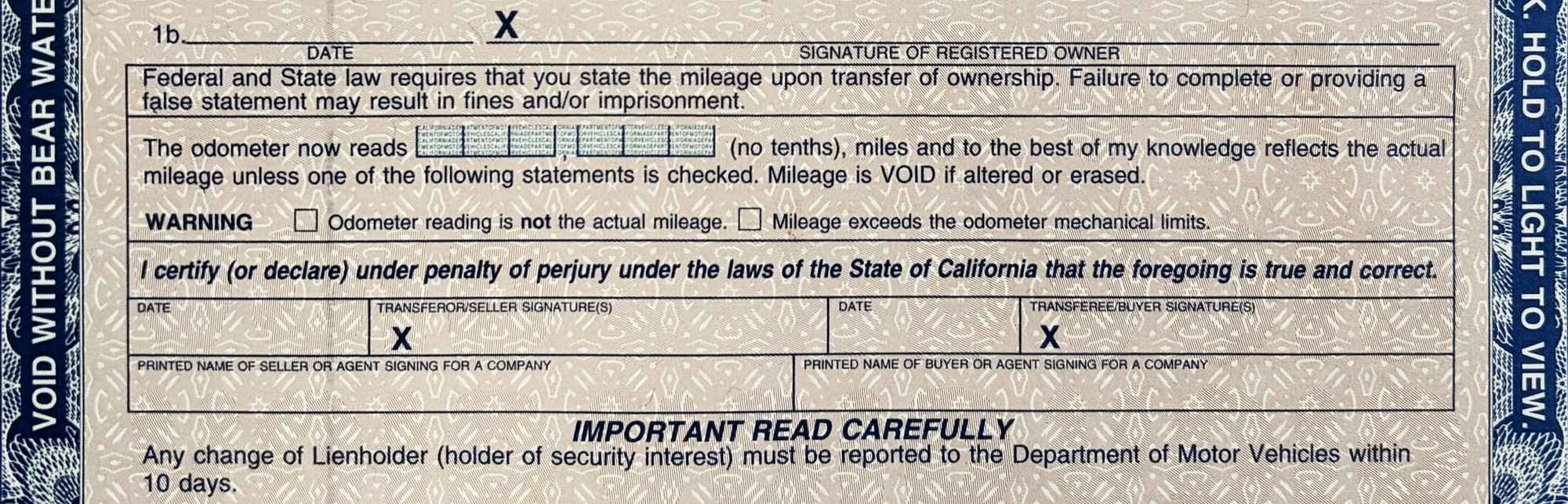
Who signs where
- The registered owner, as seller, discloses on the front of the title.
- The buyer acknowledges the same mileage on the front of the title.
- Each selling Dealer signs in the Dealer Transactions Only section on the back.
- Each buying Dealer signs in the Dealer Transactions Only section on the back.
- Once the Dealer section is full and another disclosure is still needed, a separate REG 262 has to be submitted.
If the title has no room: your state’s own document
Federal law standardized the words but left the paper to the states. When the title is full, lost, or has no usable odometer section, each state issues its own disclosure or reassignment document — some as a free PDF, some on security paper you have to pick up. There is no national form, on purpose: the federal rule requires the backup document to be issued by your state.
Your state’s form, verified
| State | Where the disclosure normally goes | When the title can’t carry it |
|---|---|---|
| Texas | The signed title, plus Form 130-U | Dealers: VTR-41-A (secure, dealer-only) |
| Florida | The title (issued on/after 4/29/1990) | HSMV 82993 (downloadable PDF) |
| Ohio | The title assignment | BMV 3724 (downloadable PDF) |
| Illinois | The title assignment | VSD 333 (downloadable PDF) |
| Michigan | The title assignment | BDVR-108 (downloadable PDF) |
| Georgia | A secure transfer document: title, dealer reassignment, or secure power of attorney | No separate disclosure form exists |
| North Carolina | The title | MVR-180 (downloadable PDF) |
| Pennsylvania | Title Section A, completed before an authorized PennDOT agent | No public form — agent-issued paperwork |
| New York | The back of the title (MV-999) | MV-103 (downloadable PDF) |
| Washington | The title | Odometer Disclosure Statement — tamper-proof paper, office pickup only |
| California | The title | REG 262 — security paper, ordered from DMV |
Each entry above was verified against the state’s own website. The remaining states are being verified and added.
When someone else can sign for you: the secure power of attorney
Normally the seller signs their own disclosure. Federal law allows one exception, and it exists for a practical problem: you cannot sign a title you do not physically have. If the bank is holding it, or it has been lost, the sale would otherwise stall.
Only when the title is out of your hands
This is not a general convenience. The rule names four situations, and the power of attorney runs from the seller to the buyer — the person taking the vehicle. It also only works if your own state allows it.
The law· 49 CFR §580.13(a) — Disclosure of odometer information by power of attorney
“If otherwise permitted by the law of the jurisdiction, the transferor may grant a power of attorney to their transferee for the purpose of mileage disclosure under one of the following conditions: (1) The transferor’s physical title is held by a lienholder; or (2) The transferor’s physical title is lost; or (3) The transferor’s electronic title is held or controlled by a lienholder; or (4) The transferor’s electronic title cannot be accessed.”
49 CFR §580.13(a)
The mileage still has to be disclosed. It goes on the power of attorney form issued by the state where the transfer happens, signed by the seller with their printed name, and it carries the same information the disclosure would have carried: the reading, the date, both parties’ names and addresses, and the vehicle.
The form has to be the state’s own
A general power of attorney a customer brings in from their lawyer is not what this rule means. It has to be the secure power of attorney form the jurisdiction issues, and states differ on who may be appointed — some allow a registration service to handle the paperwork, and some do not. Ask your own DMV before relying on it.
Odometer tampering is illegal
Federal statute prohibits every version of the scheme — the device, the act, the conspiracy, and the operation of a vehicle known to be disconnected.
Federally prohibited
- Advertising, selling, using, installing, or having installed a device that makes an odometer register a mileage different from the mileage driven
- Disconnecting, resetting, altering, or having disconnected, reset or altered an odometer intending to change the registered mileage
- Operating a vehicle with intent to defraud, knowing the odometer is disconnected or not operating
- Conspiring to violate the tampering, service-record or disclosure sections
The law· 49 U.S.C. §32703 — Preventing tampering
"A person may not — (1) advertise for sale, sell, use, install, or have installed, a device that makes an odometer of a motor vehicle register a mileage different from the mileage the vehicle was driven, as registered by the odometer within the designed tolerance of the manufacturer of the odometer; (2) disconnect, reset, alter, or have disconnected, reset, or altered, an odometer of a motor vehicle intending to change the mileage registered by the odometer; (3) with intent to defraud, operate a motor vehicle on a street, road, or highway if the person knows that the odometer of the vehicle is disconnected or not operating; or (4) conspire to violate this section or section 32704 or 32705 of this title."
49 U.S.C. §32703
Repairing or replacing an odometer
Fixing or replacing a broken odometer is legal everywhere. If the new odometer can carry the same reading as before the work, nothing else is required. If it cannot, two duties attach the moment the work is done.
Zero it, then post the notice
- The odometer is adjusted to read zero.
- A written notice goes on the left door frame: the mileage before the work, and the date of the work.
- The odometer now reads zero, so it no longer shows what the vehicle has travelled. The doorframe notice is the record of what it read before the work.
The law· 49 U.S.C. §32704(a) — Service, repair, and replacement
“A person may service, repair, or replace an odometer of a motor vehicle if the mileage registered by the odometer remains the same as before the service, repair, or replacement. If the mileage cannot remain the same— (1) the person shall adjust the odometer to read zero; and (2) the owner of the vehicle or agent of the owner shall attach a written notice to the left door frame of the vehicle specifying the mileage before the service, repair, or replacement and the date of the service, repair, or replacement.”
49 U.S.C. §32704(a)
A zeroed odometer is never actual mileage again
Section 32704 requires the notice and stops there. It does not make the doorframe figure and the new reading add up to the vehicle’s mileage, and no federal rule treats them that way. The consequence lands at the next sale: the odometer no longer reflects what the vehicle has travelled, so the disclosure cannot certify the reading as actual mileage. The Dealer states that it is not the actual mileage, and the buyer gets a warning that the two disagree.
The law· 49 CFR §580.5(e)(3) — Disclosure of odometer information upon transfer of ownership
“If the transferor knows that the odometer reading does not reflect a valid mileage display or differs from the mileage and that the difference is greater than that caused by odometer calibration error, they shall include a statement that the odometer reading does not reflect the actual mileage, and should not be relied upon. This statement shall also include a warning notice to alert the transferee that a discrepancy exists between the odometer reading and the actual mileage.”
49 CFR §580.5(e)(3)
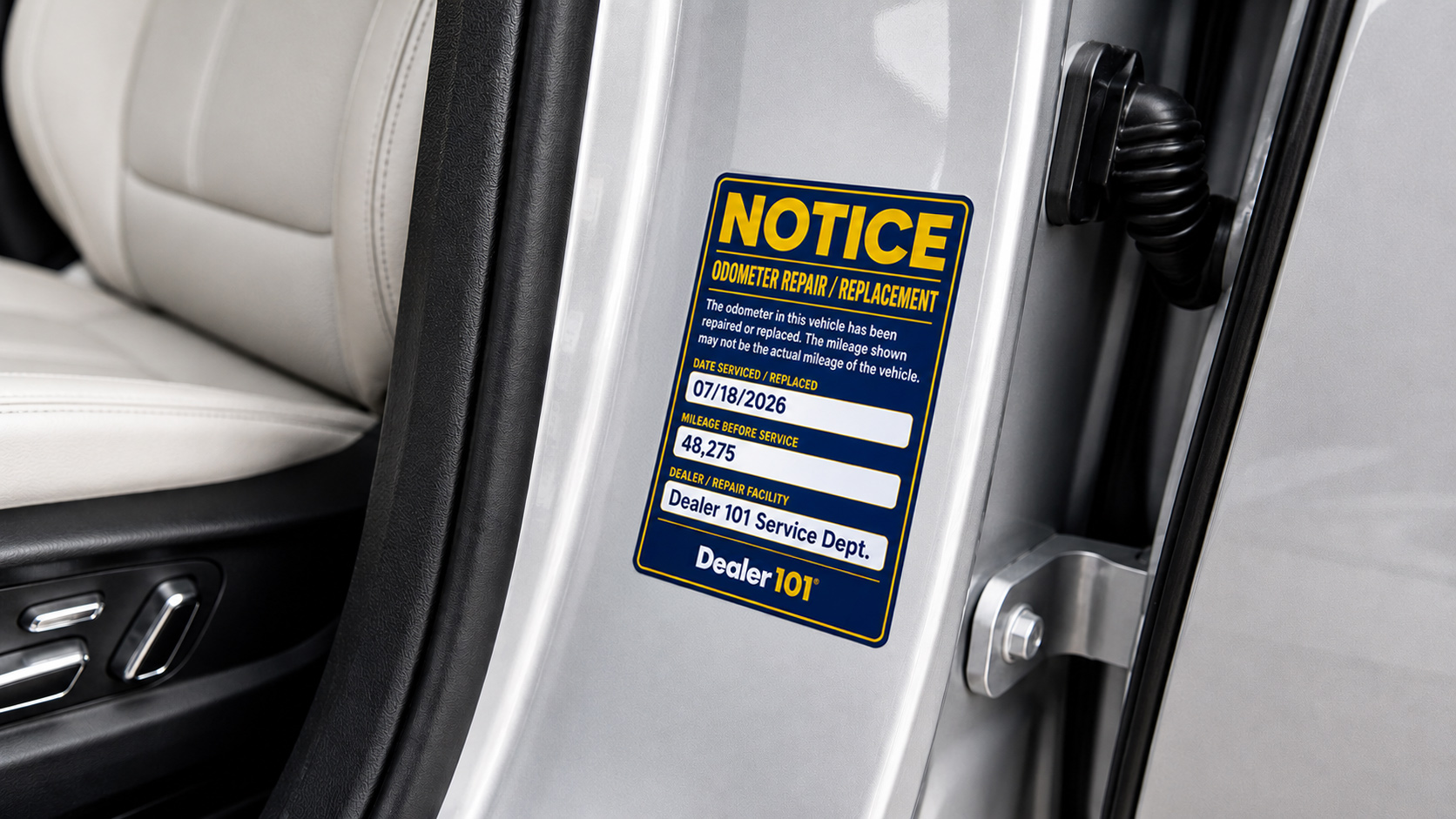
Do not remove or alter the notice
The doorframe notice is protected the same way the odometer itself is. Removing it or changing it with intent to defraud is a federal offense.
The law· 49 U.S.C. §32704(b) — Removing or altering the notice
“A person may not, with intent to defraud, remove or alter a notice attached to a motor vehicle as required by this section.”
49 U.S.C. §32704(b)
Disclosing mileage after a replacement
After a replacement, the reading on the dash is no longer the vehicle’s true mileage on its own. Unless the true mileage can be certified, the next odometer disclosure checks the “not the actual mileage” box — the certification rules in the check-box section above govern exactly when.
What a violation costs you
Odometer fraud is priced on two federal tracks at once: government civil and criminal penalties, and a private lawsuit from the buyer. Many states layer their own criminal charges on top — those live on each state’s own page.
| Track | What it costs you |
|---|---|
| Federal civil penalty | Up to $10,000 per vehicle, capped at $1,000,000 for a related series |
| Federal criminal penalty | A fine under title 18, up to 3 years imprisonment, or both |
| Private lawsuit by the buyer | 3× actual damages or $10,000, whichever is greater, plus costs and attorney’s fees |
The federal odometer chapter carries its own penalties, and they are the largest numbers on this page. A civil penalty runs per vehicle, and a knowing and willful violation is a felony-level exposure of up to three years in prison.
The federal exposure
- Civil penalty — up to $10,000 for each violation, with a separate violation for each motor vehicle or device involved.
- Series cap — a maximum of $1,000,000 for a related series of violations.
- Criminal penalty — a knowing and willful violation is punishable by a fine under title 18, imprisonment for up to 3 years, or both.
- Injunction — the Attorney General may bring a civil action to enjoin a violation.
The law· 49 U.S.C. §32709(a)(1), (b) — Penalties and enforcement
"A person that violates this chapter or a regulation prescribed or order issued under this chapter is liable to the United States Government for a civil penalty of not more than $10,000 for each violation. A separate violation occurs for each motor vehicle or device involved in the violation. The maximum penalty under this subsection for a related series of violations is $1,000,000." … "A person that knowingly and willfully violates this chapter or a regulation prescribed or order issued under this chapter shall be fined under title 18, imprisoned for not more than 3 years, or both."
49 U.S.C. §32709(a)(1), (b)
The buyer can sue you directly
The federal odometer law gives the buyer a private right of action. If you violate it with intent to defraud, the buyer can sue for three times their actual damages or $10,000, whichever is greater, and the court awards their costs and attorney's fees on top.
$10,000 minimum per buyer
- The floor is $10,000 per buyer, even when actual damages are small.
- The award is three times actual damages or $10,000, whichever is greater — treble takes over once actual damages pass about $3,334.
- The buyer's attorney's fees and costs are awarded when they win.
- The claim has to be brought within 2 years of when it accrues.
The law· 49 U.S.C. §32710 — Civil actions by private persons
"A person that violates this chapter or a regulation prescribed or order issued under this chapter, with intent to defraud, is liable for 3 times the actual damages or $10,000, whichever is greater." … "The action must be brought not later than 2 years after the claim accrues. The court shall award costs and a reasonable attorney's fee to the person when a judgment is entered for that person."
49 U.S.C. §32710
Sources
- 49 U.S.C. §32705 — disclosure requirements on transfer
- 49 CFR §580.5 — disclosure of odometer information
- 49 CFR §580.8 — five-year retention of odometer disclosures
- 49 CFR §580.17 — exemptions
- 49 U.S.C. §32703 — preventing tampering
- 49 U.S.C. §32704 — service, repair, and replacement
- 49 U.S.C. §32709 — penalties and enforcement
- 49 U.S.C. §32710 — civil actions by private persons
