

You must honor your advertised price
If you advertise a price, California requires you to actually sell the vehicle at that price. You cannot advertise one number to get a buyer in the door and then raise it at the desk. The only exception is an ad that clearly stated the price was good for a limited time — and only once that time has actually passed.
Sell it at that price
- You must sell the vehicle at the advertised price for as long as it remains unsold.
- The one exception is a clearly stated limited-time price, after that time has elapsed.
The law· VEH §11713.1(e) — selling at the advertised price
A dealer may not “fail to sell a vehicle to a person at the advertised total price … while the vehicle remains unsold, unless the advertisement states the advertised total price is good only for a specified time and the time has elapsed.”
VEH §11713.1(e)
How to write a legal car ad
Every rule on this page fits into the ad itself. Run each ad through these eight steps and it complies before it ever goes live. Each step is covered in full further down.
1. Identify the exact vehicle
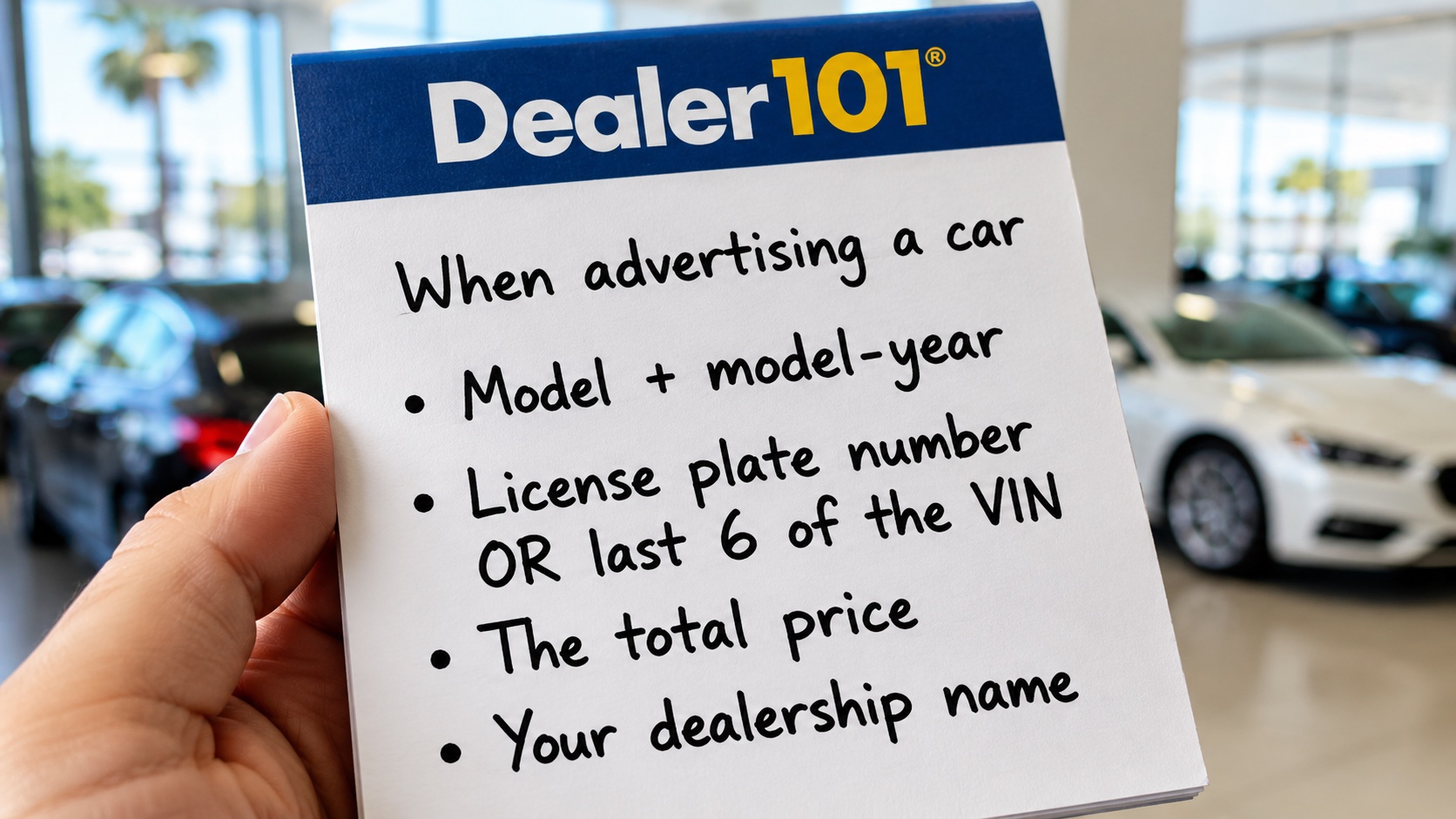
Name the model, the model-year, and either the license plate or the last six of the VIN. An ad that could describe two cars on your lot identifies neither.
2. Advertise the all-in total price
One number, everything the buyer pays except government fees, taxes and the listed dealer charges. No payment-only ads with a hidden price.
3. Say which fees get added
Taxes, registration and your document processing charge get added at signing — the ad has to say so, and none of your own fees may be dressed up as government fees.
4. Check every claim
No “invoice” or “wholesale” pricing, no “lowest price” you can’t prove, no free gifts tied to the purchase, no invented rebates, no guaranteed trade-in allowance.
5. Match the ad to the actual car
Real photos of the real car, equipment installed and working, and the car in your possession — not one you’re still watching at the auction.
6. Identify your dealership
The ad has to name your dealership, or a name that identifies you to the public and the DMV. Advertising like an anonymous private seller is a violation.
7. Sell it at the advertised price
The price holds for as long as the vehicle is unsold, unless the ad clearly stated a time limit and that time has passed.
8. Pull the ad within 48 hours of the sale
Once the vehicle sells or leaves your inventory, you have 48 hours to withdraw the ad in writing.
What counts as advertising
Before the rest of the rules make sense, you need to know what California treats as “advertising,” because it’s far broader than paid ads. It covers almost anything you communicate to the public to help sell a vehicle, in any medium. That means these rules don’t only apply to a newspaper spot or a radio read — they apply to your website, your online listings, your window stickers, and even what a salesperson says out loud on the lot.
If it reaches the public, it’s an ad
- Anything you say or post publicly to help sell a vehicle.
- That includes your website, Facebook Marketplace, Craigslist, a windshield price sticker, and social posts.
- It also includes spoken claims made to a customer on the lot.
- The same rules that apply to a printed newspaper ad apply to an online listing — the medium doesn’t change the rule.
Agency· 13 CCR §255.00 — “Advertising” Defined
“…any statement, representation, act or announcement intentionally communicated to any member of the public by any means whatever, whether orally, in writing or otherwise” … “for the purpose of arousing a desire to buy or patronize.”
13 CCR §255.00
Identify the exact vehicle
When you advertise one specific vehicle — not a general “we carry Civics” — California requires you to identify exactly which car it is. The reason is simple: a vague listing can be used to pull buyers in with a car you don’t actually have. Even if your post clearly says “2019 Honda Civic — $18,995,” it is still out of compliance if it leaves out the plate or VIN detail that pins down that one specific vehicle.
What the ad must show
- The vehicle’s model
- The vehicle’s model-year
- Either the license plate number, or the portion of the VIN that distinguishes that specific car
The law· VEH §11713.1(a) — vehicle identification in ads
A dealer may not “advertise a specific vehicle for sale without identifying the vehicle by its model, model-year, and either its license number or that portion of the vehicle identification number” that distinguishes it.
VEH §11713.1(a)
Your advertised price must be the all-in price
In our experience, this is one of the most common places dealers get written up. Whatever price you advertise has to be the full price a buyer will actually pay for the vehicle — not a stripped-down figure you build back up at the desk. California allows only a short, specific list of government and financing charges to be added on top of the advertised price. Everything else has to already be included in the number you put in the ad.
Fees you may add on top of the price
- Sales tax
- DMV vehicle registration and transfer fees
- The California tire fee
- Emission (smog) testing charges — capped at $50
- Certificate fees
- Finance charges
- Your document processing charge — capped by VEH §4456.5 at $85 with a DMV contractual agreement, $70 without
- The electronic registration or transfer charge
What must already be in the advertised price
- Reconditioning and Dealer prep
- Any pre-installed add-ons or accessories
- Any “market adjustment” or markup
The $50 cap is on the smog test charge only — not the smog certificate, which is a separate pass-through fee.
The law· VEH §11713.1(b) — advertised total price
A dealer may not “advertise the total price of a vehicle without including all costs to the purchaser at time of sale,” except for the specific charges the statute lists.
VEH §11713.1(b)
Don’t present your fees as government fees
Some of the charges on a deal are collected by the Dealer, not the government — your document processing charge, your electronic registration or transfer charge, and your emission-testing charge. California does not allow you to present any of those Dealer charges to a buyer as if they were a government or DMV fee.
Never call your fees government fees
Your document processing charge, electronic registration/transfer charge, and emission-testing charge are the Dealer’s own fees. You can itemize and collect them, but you cannot describe them to the buyer as government fees.
The law· VEH §11713.1(d) — fees represented as governmental
A dealer may not “represent the dealer document processing charge, electronic registration or transfer charge, or emission testing charge, as a governmental fee.”
VEH §11713.1(d)
“Starting at” and “from” prices need a stock count
You’re allowed to advertise a starting price, but the words come with a duty: any time an ad uses “from” or “starting at,” it has to say how many vehicles you have at that price. The count is required every time the phrase appears — whether or not you have plenty in stock.
A “starting at” price needs cars behind it
Use “from” or “starting at” in an ad and the ad must disclose the number of vehicles available at that advertised price. “Starting at $9,995 — 3 at this price.”
The law· VEH §11713.1(i) — intent not to supply demand
A dealer may not “advertise vehicles … at a specified dealer price, with the intent not to supply reasonably expectable demand, unless the advertisement discloses the number of vehicles in stock at the advertised price. In addition, whether or not there are sufficient vehicles in stock to supply a reasonably expectable demand, when phrases such as ‘starting at,’ ‘from,’ ‘beginning as low as,’ or words of similar import are used in reference to an advertised price, the advertisement shall disclose the number of vehicles available at that advertised price.”
VEH §11713.1(i)
Tell the buyer these fees will be added
Larger ads and any Dealer web page that shows a price have to say that government fees and other listed charges will be added at the time of sale. The statute even supplies the sentence that satisfies the rule.
The exact wording to put in your ad
“Plus government fees and taxes, any finance charges, any dealer document processing charge, any electronic filing charge, and any emission testing charge.” Use it in substantially that form, with no abbreviations.
The law· VEH §11713.1(c) — undisclosed price additions
A dealer may not “exclude from an advertisement of a vehicle for sale that there will be added to the advertised total price at the time of sale, charges for sales tax, vehicle registration fees, the California tire fee, the fee charged by the state for the issuance of a certificate of compliance or noncompliance pursuant to a statute, finance charges, a charge to electronically register or transfer the vehicle, and a dealer document processing charge.” It applies to print advertisements two or more columns wide, one column wide and more than seven inches long, and “a Web page of a dealer’s Internet Web site that displays the price of a vehicle offered for sale on the Internet.”
VEH §11713.1(c)
A second pricing rule arrives October 1, 2026
- Effective October 1, 2026, the California CARS Act adds Civil Code §1784.41: the vehicle’s total price must be disclosed clearly and conspicuously in any advertisement referencing a specific vehicle, and in the Dealer’s first written response to a consumer.
- The Vehicle Code rules on this page do not change — §1784.41(f) states the new rule “shall not be construed to modify vehicle advertising requirements in Section 11713.1.”
- From that date a Dealer follows both.
Keep the ad accurate
Every statement you make about a vehicle has to be true — the plain facts, and just as importantly, the vehicle’s history. California requires you to disclose a vehicle’s past life when you know it. A former taxi, rental, government, or salvage vehicle can’t be advertised as anything other than what it is.
History claims must be true
- Any statement about the vehicle’s prior use or ownership history must be accurate.
- A known former taxi, rental, publicly owned, insurance-salvage, or revived-salvage vehicle must be clearly identified as such. See our guide to vehicle history disclosure and title brands for the NMVTIS report and the required Warning label.
- You can’t call a vehicle a “demonstrator” if it was already registered or sold at retail, unless you clearly disclose that to the buyer before they sign.
Beyond this specific rule, California’s general false-advertising law and the Vehicle Code’s own ban on misleading Dealer statements both apply to anything you advertise.
The law· B&P §17500 — false advertising
“It is unlawful for any person, firm, corporation or association … to make or disseminate or cause to be made or disseminated before the public in this state … in any newspaper or other publication, or any advertising device … including over the Internet, any statement … which is untrue or misleading, and which is known, or which by the exercise of reasonable care should be known, to be untrue or misleading…”
B&P §17500
The law· VEH §11713(a) — untrue or misleading statements
“A holder of a license issued under this article shall not do any of the following: (a) Make or disseminate, or cause to be made or disseminated, before the public in this state, in a newspaper or other publication, or an advertising device, or by public outcry or proclamation, or in any other manner or means whatever, a statement that is untrue or misleading and that is known, or that by the exercise of reasonable care should be known, to be untrue or misleading…”
VEH §11713(a)
Calling a former rental “one-owner,” or a registered demo “new,” is exactly the kind of claim that draws a DMV action. If you can’t prove it, leave it out.
Agency· 13 CCR §260.02 — Vehicle History
“Express advertisements of a vehicle’s prior use or ownership history must be accurate.” “Former taxicabs, rental vehicles, publicly owned vehicles, insurance salvage vehicles and revived salvage vehicles shall be clearly identified as such if the previous status is known to the seller.” “If a vehicle is advertised and/or sold as a ‘demonstrator’ and such a vehicle has been previously registered or sold to a retail purchaser, the selling dealer shall clearly disclose to the buyer the fact of such prior registration or sale before obtaining the buyer’s signature on a purchase order or sales contract.”
13 CCR §260.02
“Demonstrator” has its own regulatory definition: “a vehicle specifically assigned by a dealer to be regularly used for the purpose of demonstrating qualities and characteristics common to vehicles of the same or similar model and type.” A car that was only occasionally test-driven by interested buyers is not a demonstrator — and calling it one is a history claim that has to be true. 13 CCR §255.02
The ad has to match the car
Five DMV regulations tie the ad to the physical car on your lot. The photos, the equipment, the availability — each one has to be true of the actual vehicle, not the vehicle you expect it to be.
The photos have to show the real car
Statements about condition have to reflect what you actually know about the car, and the pictures have to show its real overall appearance. A stock photo of the same model in a nicer trim, or last year’s photos of a car that has since picked up a door ding, doesn’t meet the rule.
The law· 13 CCR §260.03 — Vehicle Condition
“Statements of vehicle condition must accurately reflect the known condition, and pictures of vehicles must accurately depict their overall appearance.”
13 CCR §260.03
You can’t advertise a car you don’t have
The vehicle has to be in your possession before it goes in an ad. Listing a car you’re watching at the auction to see if it will sell before you buy it is exactly what this rule prohibits — until the car is in your possession, it can’t be advertised.
The law· 13 CCR §260.04 — Vehicle Availability
“No dealer shall advertise a specific vehicle or a class of vehicles for sale, unless such vehicle(s) is in the dealer’s possession, or is available to the dealer pursuant to a franchise agreement with the manufacturer or distributor of the vehicle(s).”
13 CCR §260.04
The same section also requires an advertised vehicle to be “in condition to demonstrate” and “willingly shown and sold at the advertised price” while it remains unsold — the regulation behind the honor-the-price rule at the top of this page.
Advertised equipment has to be installed and working
If the ad says the car has it, the car has it — installed and operative when the ad runs. A lift kit that’s still in the box, or a “premium sound system” with a blown amp, can’t be in the listing.
The law· 13 CCR §260.05 — Vehicle Equipment
“No specific vehicle shall be advertised as having special equipment or accessories unless such equipment or accessories are installed and operative at the time of the advertisement.”
13 CCR §260.05
The fine print has to be readable
Every qualifying statement this article requires — the limited-time price window, the fees that get added — has to be printed large enough, and shown long enough, for an average reader to actually take it in. Disclaimers that flash past or hide in tiny type don’t count as disclosed.
The law· 13 CCR §262.09 — Qualifying Statements
“Qualifying statements used in connection with vehicle advertisements, including the qualifying statements required by this article, shall be large enough and displayed for a sufficient period of time to enable the average reader or viewer to comprehend such statements.”
13 CCR §262.09
Advertise returns, and the terms go in writing
If an ad says the buyer can return the vehicle if they aren’t satisfied, the ad has to state the terms of that offer — and before the buyer signs anything, they get a written copy of those terms.
The law· 13 CCR §260.07 — Returned Vehicles
“If a dealer or lessor-retailer advertises that a vehicle may be returned if the purchaser is not satisfied, the advertisement must clearly state the terms and conditions of the offer. In addition, the dealer or lessor-retailer must furnish the buyer with a written copy of the terms and conditions of return before obtaining the purchaser’s signature to a purchase order or sales contract.”
13 CCR §260.07
Claims you can’t make in an ad
Beyond the general accuracy rule, California singles out a handful of specific sales pitches and bans them outright — or allows them only if you can back them up.
No “invoice” or “wholesale price” claims
You can’t build an ad around your own cost for the vehicle. Pitches like “$500 over invoice,” “dealer’s invoice,” or “wholesale price” are prohibited, because they invite the buyer to compare against a cost figure that isn’t a real, verifiable price. Any claim that references the Dealer’s cost is off-limits in an ad.
Off-limits language
No “invoice,” “dealer’s invoice,” or “wholesale price” language, and no advertising your price as being above, below, or at your cost.
The law· VEH §11713.1(n) — invoice and wholesale price terms
A dealer may not “use ‘invoice,’ ‘dealer’s invoice,’ ‘wholesale price,’ or similar terms that refer to a dealer’s cost for a vehicle in an advertisement for the sale of a vehicle.”
VEH §11713.1(n)
No “lowest price” claims you can’t prove
You can tell buyers you’re competitive, but you can’t claim you’re the cheapest unless you have actually verified it. Pitches like “we have the lowest prices” or “we’ll beat any dealer’s price” are only allowed if you’ve run a recent survey showing you really do sell for less than another Dealer in your area — and you keep the records that prove it.
Prove it or don’t say it
- You can’t claim “lowest prices” or “we’ll beat any dealer’s price”…
- …unless a recent survey shows you actually sell lower than another Dealer in your trade area…
- …and you keep records that substantiate the claim.
The law· VEH §11713.1(r) — underselling claims
A dealer may not “advertise an underselling claim, including … ‘we have the lowest prices’ or ‘we will beat any dealer’s price,’ unless the dealer has conducted a recent survey … and maintains records to adequately substantiate the claims.”
VEH §11713.1(r)
No “free gift with purchase”
If the only way a customer gets the “free” item is by buying a vehicle, it isn’t free — and California doesn’t let you advertise it that way. A “free TV with every purchase” offer ties the gift to the sale, which is exactly what the rule prohibits.
“Free” tied to a purchase isn’t free
Merchandise, gifts, or services a buyer can only get by purchasing a vehicle cannot be advertised as free.
The law· VEH §11713.1(h) — free gifts with purchase
A dealer may not “advertise free merchandise, gifts, or services provided by a dealer contingent on the purchase of a vehicle.”
VEH §11713.1(h)
No guaranteed trade-in allowance
You can’t promise a specific trade-in value in an ad before you’ve ever seen the customer’s vehicle. A pitch like “$5,000 minimum for any trade” guarantees an amount you have no way of honoring for every car that rolls in, so California bans guaranteed trade-in allowances in advertising.
Never promise a trade-in amount
Any ad that promises a fixed or minimum trade-in amount — regardless of the vehicle’s actual condition or value — is not allowed. You can advertise that you accept trades; you just can’t guarantee what they’re worth.
The law· VEH §11713.1(l) — guaranteed trade-in allowance
A dealer may not “advertise a guaranteed trade-in allowance.”
VEH §11713.1(l)
No “rebate” or “cash back” you invented
A rebate in an ad has to be a real one. Unless the money comes from the manufacturer, a manufacturer-affiliated finance company, a regulated utility, or a government entity — in a specific dollar amount — the words are off-limits. A “$1,000 cash back” that you fund yourself by moving numbers around on the deal is exactly what this bans.
When “rebate” is allowed
- The rebate is expressed in a specific dollar amount, and
- It is in fact offered by the vehicle manufacturer or distributor, a finance company affiliated with one, a regulated utility, or a governmental entity, directly to the retail purchaser or their assignee.
- A Dealer-funded discount dressed up as a “rebate” or “cash back” fails both tests.
The law· VEH §11713.1(j) — rebate advertising
A dealer may not “use ‘rebate’ or similar words, including, but not limited to, ‘cash back,’ in advertising the sale of a vehicle unless the rebate is expressed in a specific dollar amount and is in fact a rebate offered by the vehicle manufacturer or distributor, a finance company affiliated with a vehicle manufacturer or distributor, a regulated utility, or a governmental entity directly to the retail purchaser of the vehicle or to the assignee of the retail purchaser.”
VEH §11713.1(j)
No bait-and-switch
You can’t advertise a vehicle, or a price, to draw buyers in and then steer them onto something else. Advertising a car you don’t genuinely intend to sell, so you can switch the buyer to a different (usually pricier) one, is classic bait-and-switch — and California adopts the federal FTC rules against it. The $8,995 special that is always “just sold” by the time the caller gets there is the textbook version.
Never advertise a car as bait
The law· VEH §11713.1(o) — bait and switch
A dealer may not “violate a law prohibiting bait and switch advertising, including … the guides against bait advertising set forth in Part 238 … of Title 16 of the Code of Federal Regulations.”
VEH §11713.1(o)
Effective October 1, 2026, the California CARS Act adds a separate list of 13 subjects a Dealer may not misrepresent, including add-on costs, financing terms, and whether a customer has been preapproved. Those duties sit in the Civil Code and apply in addition to the claims banned on this page.
Identify your dealership in the ad
A licensed Dealer can’t advertise like an anonymous private seller. Every ad has to identify who you are, so buyers and the DMV can tell a Dealer is behind it. Hiding that you’re a licensed Dealer — the tactic behind curbstoning — is a violation.
Put your name on it
- Put your dealership’s name — the DBA you’re licensed under — in the ad.
- The name has to identify you clearly to both the public and the DMV.
Agency· 13 CCR §262.08 — Identity of Dealer or Lessor-Retailer
“Advertisements by dealers or lessor-retailers shall identify the dealer or lessor-retailer either by the name under which the licensee does business or by such other name as will serve to readily identify the dealer or lessor-retailer both to the public and the department.”
13 CCR §262.08
Remove the ad within 48 hours of the sale
Once a vehicle sells, or you pull it from the market for any reason, its ad has to come down quickly. California gives you 48 hours to withdraw it, in writing, everywhere you posted it. Sell the car on a Saturday, and the Facebook Marketplace and Autotrader listings need to be gone by Monday. A listing left up for a car that’s already gone is visible to anyone who looks, including the DMV.
The 48-hour clock
- When a vehicle sells, or you take it off the market, you have 48 hours to remove the ad from every place you ran it.
- “In writing” means both: notify each platform in writing that the ad should come down, and keep proof of that notice.
Starting October 1, 2026, this section also shields you under a second law. Civil Code §1784.40(d) makes it a violation to misrepresent whether a vehicle is available at a total price you communicated, and states a Dealer is not in violation if the advertisement was withdrawn in compliance with this 48-hour rule. See the California CARS Act.
The law· VEH §11713(c) — 48-hour ad withdrawal
A dealer may not “fail, within 48 hours, to withdraw in writing an advertisement of a vehicle that has been sold or withdrawn from sale.”
VEH §11713(c)
What a violation costs you
Breaking these rules carries real consequences, and they come on two levels. Every advertising rule on this page is part of California’s occupational-licensing law, so a violation of any of them is a crime — and if the ad was actually false or misleading, a second, heavier set of penalties stacks on top.
| What you did | What it costs you |
|---|---|
| Any advertising rule on this page | Misdemeanor under VEH §40000.11 |
| A false or misleading ad — criminal | Up to 6 months in county jail and/or a $2,500 fine (B&P §17500) |
| A false or misleading ad — civil | Up to $2,500 per violation, sought by a prosecutor (B&P §17536) |
| Your Dealer license | The DMV may suspend or revoke it after notice and a hearing (VEH §11705) |
Every rule here is a misdemeanor
Every rule covered above lives in Division 5 of the Vehicle Code — the part governing Dealer licensing and business practices. The code classifies a violation of anything in that division as a misdemeanor, which means any single advertising slip below is a criminal violation, not just a paperwork problem.
The violations
- Advertising a specific vehicle without its model, model-year, and plate or VIN portion
- Advertising a price that isn’t the full, all-in price
- Presenting your doc, e-registration, or smog-test fee as a government fee
- Failing to sell at the advertised price with no valid limited-time notice
- Advertising “from” or “starting at” prices without disclosing how many you have in stock
- Advertising free gifts or merchandise contingent on a purchase
- Advertising off Dealer cost — “invoice,” “dealer’s invoice,” or “wholesale price”
- Advertising a guaranteed trade-in allowance
- “Lowest price” or “we’ll beat any price” claims without survey records
- Advertising “rebate” or “cash back” that is not a specific-dollar manufacturer, utility, or government rebate
- Leaving the added-fees statement out of a larger ad or a priced web listing
- Bait-and-switch advertising
- Inaccurate history claims, or failing to disclose a former taxi, rental, government, or salvage vehicle
- Misusing “demonstrator” on a previously registered or sold car
- Advertising without identifying your dealership
- Leaving a sold or withdrawn ad up more than 48 hours
The law· VEH §40000.11 — misdemeanor classification
The Vehicle Code classifies a violation of “Division 5 (commencing with Section 11100), relating to occupational licensing and business regulations” as a misdemeanor.
VEH §40000.11
False or misleading ads are a crime on their own
If an ad isn’t just technically non-compliant but actually false or misleading, it triggers California’s false-advertising law directly. That carries its own criminal penalty, and a prosecutor can add a civil penalty on top — a separate track from any DMV license action.
What it costs you
- A false or misleading ad is a misdemeanor — up to six months in county jail and/or a $2,500 fine.
- On top of that, a prosecutor can seek a civil penalty of up to $2,500 for each violation.
The law· B&P §17500 — false advertising
“Any violation of the provisions of this section is a misdemeanor punishable by imprisonment in the county jail not exceeding six months, or by a fine not exceeding two thousand five hundred dollars ($2,500), or by both that imprisonment and fine.”
B&P §17500
The law· B&P §17536 — civil penalty
“Any person who violates any provision of this chapter shall be liable for a civil penalty not to exceed two thousand five hundred dollars ($2,500) for each violation.”
B&P §17536
The DMV can suspend or revoke your Dealer license
Criminal penalties are only one side of it. Separately from anything a prosecutor does, the DMV has its own authority to act against your license. The advertising rules on this page all sit inside Article 1 of Chapter 4 of Division 5 of the Vehicle Code, and violating any provision of that article is listed grounds for the department to suspend or revoke a Dealer license after notice and a hearing.
Your license is at risk
- An advertising violation can put your Dealer license itself at risk, not just expose you to a fine.
- The DMV must give you notice and a hearing before it suspends or revokes the license.
- This is a separate track from any criminal case or civil penalty — they can happen alongside each other.
The law· VEH §11705(a)(10) — license suspension or revocation
The department “may suspend or revoke the license issued to a dealer” upon determining that the licensee has “violated any provision of Article 1 (commencing with Section 11700) of, or Article 1.1 (commencing with Section 11750) of, Chapter 4 of Division 5 or any rule or regulation adopted pursuant thereto.”
VEH §11705(a)(10)
Sources
- VEH §11713.1 — Dealer advertising (all subdivisions)
- VEH §11713 — prohibited acts, incl. 48-hour ad withdrawal
- B&P §17500 — California false advertising law
- B&P §17536 — civil penalty for false advertising
- VEH §40000.11 — Division 5 violations classified as misdemeanors
- VEH §11705 — DMV authority to suspend or revoke a Dealer license
- 13 CCR §255.00 — “Advertising” defined
- 13 CCR §260.02 — Vehicle history / accuracy
- 13 CCR §260.03 — Vehicle Condition
- 13 CCR §260.04 — Vehicle Availability
- 13 CCR §260.05 — Vehicle Equipment
- 13 CCR §260.07 — Returned Vehicles
- 13 CCR §262.08 — Identity of Dealer or lessor-retailer
- 13 CCR §262.09 — Qualifying Statements
