

Dealer 101® · CA DMV Approved #CCC0052
In effect since October 1, 2026 · Updated
California CARS Act: What Dealers Have to Do Now
Every used car you sell or lease for $50,000 or less now comes with a free right to cancel within 3 business days. This guide covers what changed, the forms you need, and what to do when a buyer brings a car back.
6 things every California dealer has to know about the CARS Act
The CARS Act applies to all licensed California dealers engaging in retail sales or leases of light-duty vehicles under 10,000 lbs, with certain exemptions (for example, wholesale, fleet, and auction). Each item below links to the section that explains it, and your checkmarks stay saved on this device.
Show the total price in every ad and first reply
This is a new duty in the Civil Code. It sits on top of the Vehicle Code advertising rules, which didn't change, so you follow both.
Where the total price has to appear
- In any ad for a specific vehicle, whether or not it shows a price or payment.
- In your first written reply to a customer about a specific vehicle, a dollar amount, or a financing term. DMV's bulletin lists email, text, a quote, and a credit application as examples. Keep that reply, and give the customer a copy if they ask in writing.
What counts as the total price
The total price is the full sale price, minus only the taxes, fees, and charges that Vehicle Code §11713.1(e) already lets you add on top. It includes any dealer price adjustment and anything installed on the car when you advertise it. A rebate doesn't come off it.
The law· CIV §1784.31(j) — “total price” defined
“‘Total price’ means the total sale price of a vehicle, excluding the taxes, fees, and charges described in subdivision (e) of Section 11713.1 of the Vehicle Code. … ‘Total price’ includes any dealer price adjustment and the cost of any item installed on the vehicle at the time of the advertisement or communication. … ‘Total price’ does not include any deduction for a rebate.”
CIV §1784.31(j)
Write your total-price line
Fill in your car and price, then copy the line into your ad or your first reply to the customer. If you charge document or electronic filing fees, enter them so the line tells the customer about them too.
Our guide to California Dealer advertising laws covers the Vehicle Code rules, and it is still accurate.
The law· CIV §1784.41(f) — advertising requirements unaffected
“Subdivision (a) shall not be construed to modify vehicle advertising requirements in Section 11713.1 or Section 11713.16 of the Vehicle Code. This includes, but is not limited to, the advertisement or communication of rebates and incentives that are disclosed separately from a vehicle’s total price.”
CIV §1784.41(f)
Download free CARS Act forms and notices for your dealership
These are free versions of the notices and forms the law requires, plus three that make it easier to follow. Fill them in on screen, print them, or edit them in Word. Click any page to see it full size.
For your wall
3-day cancellation notice
Post it in every sales office, cubicle, and signing room.
Motorcycle and off-highway sheet
Post it beside the notice if you sell either one at that location.
For every buyer
3-Day Right to Cancel form
Give it on every qualifying used sale or lease at $50,000 or less.
Add-on and payment disclosure
Use it whenever you put an add-on or a monthly payment in writing.
Condition at delivery sheet
Records how the car left, in case it comes back.
When a buyer cancels
Cancellation receipt
Itemizes every deduction and shows when the buyer cancelled.
"A buyer wants to cancel" desk card
One page with every step, to keep by the desk.
CARS Act records checklist
Lists the five kinds of records the act makes you keep.
If you negotiate in Spanish, Chinese, Tagalog, Vietnamese, or Korean, the law requires the 3-day form and the add-on disclosures in that language too. We publish English and Spanish versions, and forms publishers sell the other four.
What to do when a buyer cancels within 3 business days
A business day is any day your dealership is open to the public. A buyer who signs on Friday at a dealership open Saturday and Monday can bring the car back as late as Monday. This section covers what you can charge, the last day they can cancel, and what you owe them in the 48 hours after they do.
Check the restocking fee and the cancellation deadline
Enter the deal below. The fee math follows Civil Code §1784.31, and the deadline counts 3 business days, the days your dealership is open. If you charged the buyer for shipping, you may keep your actual shipping cost instead of the 1.5% fee, but never more than that fee.
| Restocking fee1.5% of the sale price, at least $200 and at most $600 | |
| Mileage charge$1 for each mile over 250, up to $150 | |
| The most you can charge | |
| Last day to cancelThe 3rd business day after signing, until close of business |
Refund the buyer within 48 hours
- Write down the date and time the buyer cancelled. The law requires it on the cancellation receipt.
- Check the car in. The buyer brings it in person during business hours, along with any cash or items they received with the deal. The car has to be free of liens other than the ones from this deal, and in the same condition you delivered it, except for reasonable wear and tear and problems the buyer didn't cause.
- Figure the fee with the calculator, and take it out of the refund. If the refund doesn't cover it, the buyer pays the difference when they cancel.
- Settle the trade-in. The next section explains what you owe.
- Refund the buyer within 48 hours. Delays caused by a bank or card processor don't count against you. If the buyer paid by check, you can wait until 2 business days after the check is verified, and you show them when that happened.
- Give the buyer the cancellation receipt, with every deduction itemized, and keep a copy with the deal.
The law· CIV §1784.43(d)(1) — 48-hour unwind
“No later than 48 hours after the buyer or lessee exercises the right to cancel pursuant to this section, the dealer shall cancel the contract and provide the buyer or lessee with a full refund, minus any deduction allowed by this section. The dealer is not responsible for any delays outside the control of the dealer, including delays attributable to the processing of a refund by a bank, credit card company, or other financial institution.”
CIV §1784.43(d)(1)
Return the trade-in or pay for it
If you still have the trade-in, give it back along with every key the buyer handed you. If you already sold it or started the title transfer, you pay the buyer the greatest of three amounts: the trade-in value in the contract, the price you sold it for, or its fair market value. You can subtract what it takes to pay off a loan on the trade-in.
Two ways of setting fair market value are presumed correct unless someone proves otherwise. One is a written offer the buyer received, good for at least 7 days, that you honor. The other is the trade-in value in a nationally recognized pricing guide on the day the buyer cancels, for the car's condition when it was traded. If you tell the buyer you sold their trade-in, give them a copy of that sale with the new owner's personal information removed.
The law· CIV §1784.43(a)(3)(A) — trade-in return
“If the right to cancel is exercised, the dealer shall return the buyer’s or lessee’s trade-in vehicle and all keys the buyer or lessee provided, if any, unless the dealer has sold or otherwise initiated the process to transfer the title of the trade-in vehicle, in which case the refund for the trade-in vehicle is the greater of the following: (i) The agreed-upon value of the trade-in vehicle in the sales or lease agreement. (ii) The amount for which the dealer sold the trade-in vehicle. (iii) The fair market value of the trade-in vehicle.”
CIV §1784.43(a)(3)(A)
Seven things a dealer can't do when a buyer cancels
- Anything that interferes with the buyer canceling.
- Charge more than the allowed restocking fee.
- Hold back or delay the down payment refund or the return of the trade-in.
- Fail to pay for a trade-in you already sold.
- Fail to give the buyer the receipt or contract for the sale of their trade-in.
- Claim damage beyond reasonable wear and tear without a reasonable basis.
- Claim that the person who can return the money or the trade-in isn't available.
The law· CIV §1784.43(c) — prohibited acts on cancellation
“It is a violation of this title for any dealer, in connection with a buyer or lessee exercising the right to cancel, to do any of the following: (1) Anything to impede a buyer or lessee from exercising the right to cancel … (2) Overcharge the buyer or lessee for the restocking fee. (3) Withhold the buyer’s or lessee’s downpayment or trade-in vehicle after the right to cancel has been exercised.”
CIV §1784.43(c)
Deals the 3-day right doesn't cover
The right applies to used vehicles only, and these sales don't get it:
| Sale Type | Why it isn't covered |
|---|---|
| Priced over $50,000 | Vehicles priced over $50,000 are exempt from the 3-day right. |
| Motorcycles | Motorcycles are exempt from the 3-day right. |
| 10,000 lbs GVWR or more | Vehicles with a GVWR of 10,000 lbs or more are exempt from the Act. |
| Wholesale and fleet sales, and business buyers of 5 or more a year | The act doesn't count these as covered sales. |
| Vehicles that don't have to be registered | The act doesn't count them as vehicles. |
| Auction sales under Vehicle Code Division 12 | Vehicles sold at these auctions are exempt from the 3-day right. |
| A lessee buying out a car they already have | Lease buyouts by the lessee are exempt from the 3-day right. |
The law· CIV §1784.31(f)(2) — Definitions
“(2) Notwithstanding paragraph (1), ‘motor vehicle’ or ‘vehicle’ does not include any of the following: (A) Vehicles that are sold wholesale. For purposes of this subparagraph, ‘wholesale’ means sale of a vehicle that does not constitute a retail sale, as defined in Section 6007 of the Revenue and Taxation Code. (B) Vehicles that are not required to be registered under the Vehicle Code. (C) Fleet sale transactions. For purposes of this subparagraph, ‘fleet sale’ means the sale of more than one vehicle as part of a single transaction for use primarily for business or commercial purposes. (D) Sales to commercial purchasers. For the purposes of this subparagraph, ‘commercial purchasers’ means a person that purchases five or more vehicles from the dealer per year for use primarily for business or commercial purposes. (E) A vehicle that has a gross vehicle weight rating of 10,000 pounds or more.”
CIV §1784.31(f)(2)
The law· CIV §1784.43(a)(1) — right to cancel
“A dealer shall not sell or lease a used vehicle at retail at a price equal to or less than fifty thousand dollars ($50,000) without providing the buyer or lessee with a three-day right to cancel the purchase or lease. … The right to cancel does not apply if the used vehicle has been driven more than 400 miles between the execution of the sale or lease agreement and the date on which the buyer or lessee attempts to exercise the right.”
CIV §1784.43(a)(1)
400 miles ends the right, and 250 miles starts the charge
After 400 miles there's no right to cancel at all. Below 400, the right stands, but each mile past 250 adds $1 to the restocking fee, up to $150.
Check before you rely on it for an RV
The old law excluded RVs by name, and the new one doesn't. Most RVs are still outside the act because they weigh 10,000 lbs GVWR or more, but a lighter RV may be covered.
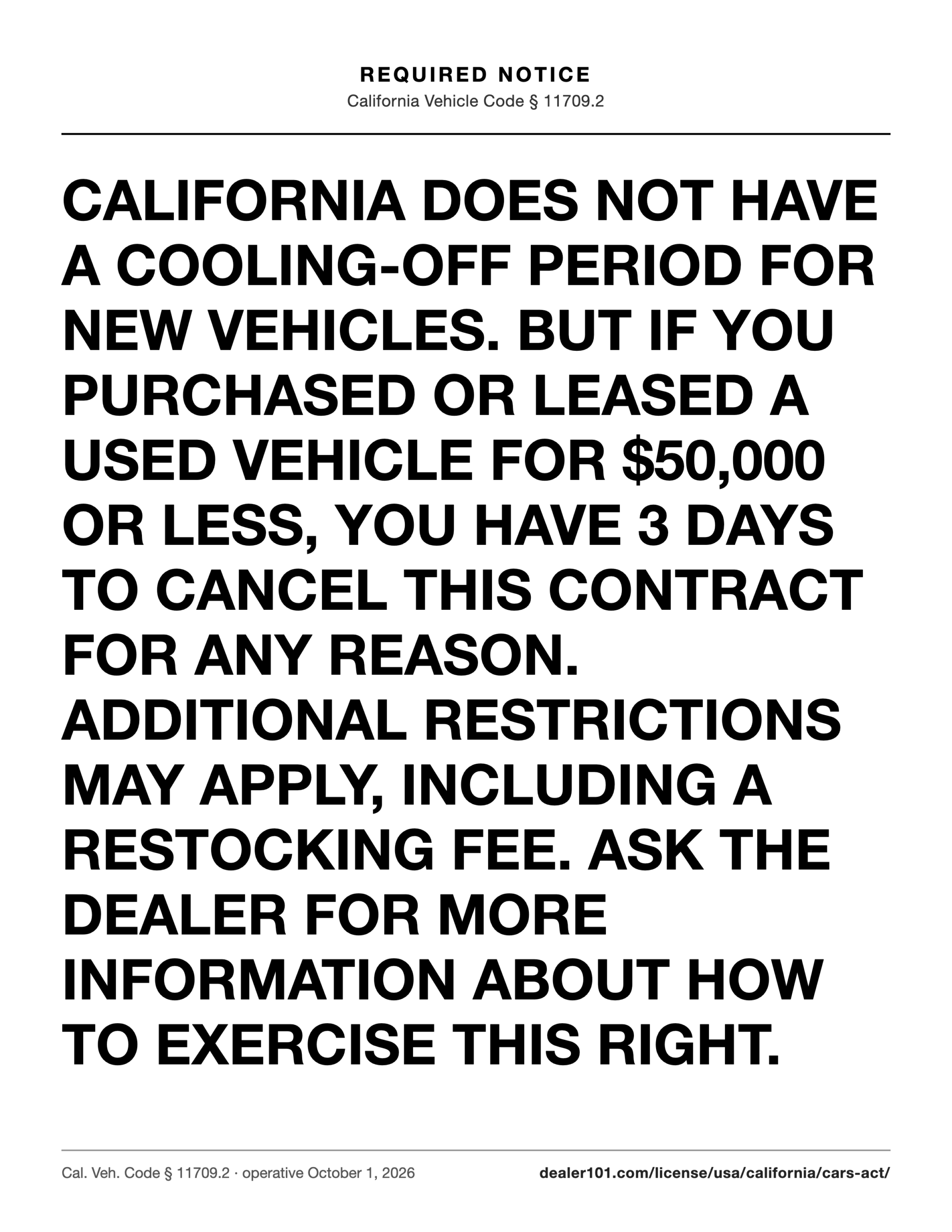
Post the 3-day cancellation notice in every sales office
The new notice goes in the same rooms as the old one. What changed is the wording and the size rule: the law now requires at least 36-point type instead of an 8 by 10 inch sheet.
- Post a physical notice in each sales office and cubicle where written deal terms are discussed.
- Post one in each room where sale and lease contracts are regularly signed.
- If you also sell motorcycles or off-highway vehicles at that location, post the extra sheet beside it. The law treats the two sheets as one notice.
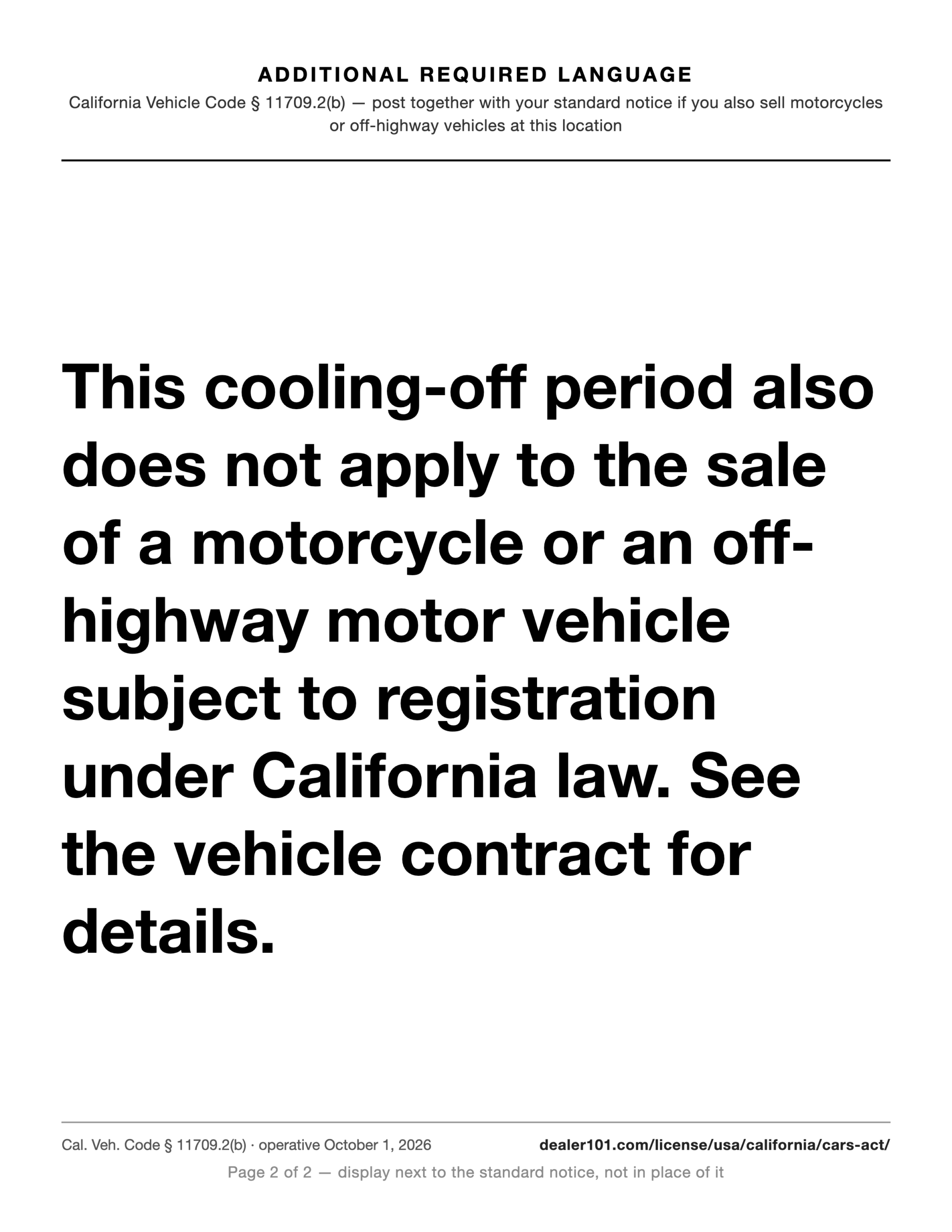
At 36-point type the two paragraphs don't fit on one letter-size sheet, which is why a dealer who sells motorcycles or off-highway vehicles posts both sheets together.
The law· VEH §11709.2(a) — posted cancellation notice
“Every dealer shall conspicuously display a physical notice, in at least 36-point type, in each sales office and sales cubicle of a dealer’s established place of business where written terms of specific sale or lease transactions are discussed with prospective purchasers or lessees, and in each room of a dealer’s established place of business where sale and lease contracts are regularly executed that states the following: ‘CALIFORNIA DOES NOT HAVE A COOLING-OFF PERIOD FOR NEW VEHICLES. BUT IF YOU PURCHASED OR LEASED A USED VEHICLE FOR $50,000 OR LESS, YOU HAVE 3 DAYS TO CANCEL THIS CONTRACT FOR ANY REASON. ADDITIONAL RESTRICTIONS MAY APPLY, INCLUDING A RESTOCKING FEE. ASK THE DEALER FOR MORE INFORMATION ABOUT HOW TO EXERCISE THIS RIGHT.’”
VEH §11709.2(a)
The law· VEH §11709.2(b) — cancellation notice exclusions
“This cooling-off period also does not apply to the sale of a motorcycle or an off-highway motor vehicle subject to registration under California law. See the vehicle contract for details.”
VEH §11709.2(b)
The 3-day form, the contract box, and the cancellation receipt
Three documents changed. You hand the buyer a new 3-day form, your contract carries a new box on page 1, and you give a receipt if the buyer cancels.
The 3-Day Right to Cancel form and its 9 required items
The form is a separate sheet titled exactly "3-Day Right to Cancel Used Car Purchase or Lease." It has to clearly cover these nine things:
- The dealer's name and the buyer's name
- A description of the vehicle and its VIN
- The deadline to cancel and return the car
- That the right is free, that a restocking fee may apply, and how both parts of the fee are figured
- That the right ends after 400 miles
- What the buyer must bring back in person, during business hours
- That you may ask the buyer to sign papers to unwind the deal
- What you pay for a trade-in you already sold
- That you give the buyer a copy of the trade-in sale if you say you sold it
If you negotiated mostly in Spanish, Chinese, Tagalog, Vietnamese, or Korean, you also hand the buyer the form in that language. Our version is in the free forms in English and Spanish.
The law· CIV §1784.43(b) — the cancellation disclosure
“Notwithstanding Section 2981.9 of the Civil Code, a dealer shall provide the buyer or lessee of a used vehicle subject to the right to cancel a copy of a disclosure titled ‘3-Day Right to Cancel Used Car Purchase or Lease’ on a separate document. If the transaction is negotiated primarily in a language identified by subdivision (b) of Section 1632, the disclosure required by this subdivision shall also be provided in that language.”
CIV §1784.43(b)
The new cancellation box on page 1 of the contract
The old box that said there is no cooling-off period unless the buyer purchases a contract cancellation option is gone, on both sales and leases. This is the wording that replaced it:
CALIFORNIA DOES NOT HAVE A COOLING-OFF PERIOD FOR NEW VEHICLES. HOWEVER, IF YOU PURCHASED OR LEASED A USED VEHICLE FOR $50,000 OR LESS, YOU HAVE 3 DAYS TO CANCEL THIS CONTRACT FOR ANY REASON. ADDITIONAL RESTRICTIONS MAY APPLY, INCLUDING A RESTOCKING FEE.You have up to 3 days to return the vehicle to the dealer and cancel this contract and obtain a refund. Please review the disclosure, which the dealer is required by law to provide, for the details about this right and how to exercise it.
Your contracts come from a forms publisher or your dealer software, and no state agency publishes model forms. Compare page 1 of your contract with the box above. Sale contracts point to it in Civil Code §2982(r), and leases in §2985.8(e).
The law· CIV §1784.43(e) — required notice text
“CALIFORNIA DOES NOT HAVE A COOLING-OFF PERIOD FOR NEW VEHICLES. HOWEVER, IF YOU PURCHASED OR LEASED A USED VEHICLE FOR $50,000 OR LESS, YOU HAVE 3 DAYS TO CANCEL THIS CONTRACT FOR ANY REASON. ADDITIONAL RESTRICTIONS MAY APPLY, INCLUDING A RESTOCKING FEE. You have up to 3 days to return the vehicle to the dealer and cancel this contract and obtain a refund. Please review the disclosure, which the dealer is required by law to provide, for the details about this right and how to exercise it.”
CIV §1784.43(e)
The cancellation receipt you give when a buyer cancels
When a buyer cancels, give them a receipt that itemizes the reason for every deduction and shows the date and time they cancelled. Our receipt is in the free forms.
The law· CIV §1784.43(a)(3)(B) — the cancellation receipt
“The dealer shall provide the buyer or lessee a receipt documenting the cancellation that includes an itemized breakdown of the basis for each deduction. The receipt shall include the date and time when the buyer or lessee exercised the right to cancel.”
CIV §1784.43(a)(3)(B)
Disclose add-ons and payment totals in writing
Tell buyers every add-on is optional
Any time you put an add-on in writing while negotiating a specific car, you have to say at least once that it isn't required and that the buyer can buy or lease the car without it. DMV's bulletin adds that you also disclose it verbally.
The law· CIV §1784.41(b) — add-on representations
“When making any written representation during the negotiation to purchase or lease a specific vehicle about an add-on product or service, the dealer shall disclose at least once that the add-on is not required and the consumer can purchase or lease the vehicle without the add-on. This disclosure shall be in writing and shall be clear and conspicuous.”
CIV §1784.41(b)
Show the total cost of a monthly payment
Any time you put a monthly payment in writing, show at least once the total the buyer will pay after every scheduled payment. If that total assumes a down payment or a trade-in, show that amount too. If you compare payment options in writing and one has a lower monthly payment, add that lower monthly payments often raise the total paid. An online payment tool the customer adjusts doesn't trigger that line by itself.
These disclosures can go on the same document as your §2982.2 disclosures, and the language rule applies to the add-on and monthly-payment disclosures. Our add-on disclosure covers all three.
The law· CIV §1784.41(c)(1) — monthly payment representations
“When making any written representation during the negotiation to purchase or lease a specific vehicle about a monthly payment for any vehicle, the dealer shall disclose at least once, clearly and conspicuously and in writing, the total amount the consumer will pay to purchase or lease the vehicle at that monthly payment after making all payments as scheduled.”
CIV §1784.41(c)(1)
The law· CIV §1784.41(d) — payment comparisons
“(d) If the dealer makes any written comparison between payment options during the negotiation to purchase or lease a specific vehicle that includes discussion of lower monthly payments, the dealer shall disclose that lower monthly payments often increase the total amount the consumer will pay to purchase or lease the vehicle. Use of an internet-based tool that allows consumers to adjust financing parameters shall not constitute a violation of this section.”
CIV §1784.41(d)
Add-ons you can't charge for at all
You can't charge for an add-on the buyer can't benefit from. The law gives these examples, and the list isn't complete:
- Nitrogen tire fills that are less than 95% pure
- Products or services that don't provide coverage for the vehicle, the buyer, or the deal
- A GAP agreement that doesn't comply with §2982, §2982.2, or §2982.12
- A service contract that is void because of a preexisting condition, such as prior crash or flood damage
- Oil changes for an electric vehicle
- Catalytic converter marking on a car that doesn't have one
- Surface protection that voids the factory paint warranty
An add-on the buyer chose and would benefit from is fine, even if they never use it. You also have to pay the add-on provider within 10 days of signing, unless your agreement with them allows later payment and the buyer's coverage isn't affected.
The law· CIV §1784.42 — no-benefit add-ons
“A dealer may not charge for an add-on product or service if the vehicle purchaser or lessee would not benefit from the add-on product or service … A dealer shall pay the person or entity who is supposed to provide the benefit of the add-on within 10 days of the date when the car buyer or lessee signs the purchase or lease, unless the dealer has an agreement with the person or entity that provides for payment at a later date and the buyer’s or lessee’s coverage is not impacted by the later payment. … This section does not prohibit a dealer from charging for an add-on product or service, such as a service contract, if the add-on product or service is selected by, and would benefit, the vehicle purchaser or lessee, even if the vehicle purchaser or lessee ultimately does not choose to use the add-on product or service…”
CIV §1784.42
Never misrepresent these 13 things
A misrepresentation about any of these is a violation on its own, and most of them come up on every deal.
- The cost or terms of buying, financing, or leasing
- Any cost, limit, or benefit of an add-on
- Whether the final contract is a lease or a sale
- Whether cars are available at a total price you quoted
- Whether a customer is preapproved or guaranteed for anything
- Anything about a customer's financing application
- Whether you will keep a down payment or trade-in, charge fees, or take legal action if the deal doesn't close
- Whether and when you will pay off the loan or lease on a trade-in
- The customer's remedy if you don't sell at the total price
- Any tie to, or endorsement by, a government agency
- Whether or when a car can be repossessed
- Whether a car can be taken outside California or the U.S.
- Any disclosure this act requires
On availability, a rule you already follow protects you: pull the ad within 48 hours of the sale, as Vehicle Code §11713(c) requires.
The law· CIV §1784.40 — misrepresentation
“It is a violation of this title for any dealer to make any misrepresentation regarding material information about any of the following: (a) The costs or terms of purchasing, financing, or leasing a vehicle. (b) Any costs, limitation, benefit, or any other aspect of an add-on product or service. … (d) The availability of vehicles at a total price communicated by the dealer.”
CIV §1784.40
Keep CARS Act records for 2 years
Failing to keep these records is a violation by itself. Keep each one for 2 years from the day it was made, in any legible form, the same way you keep your other records.
- Total-price ads and first replies, including internet listings.
- Signed deal paperwork, even if the contract was never approved or assigned, plus your written messages with anyone who signed.
- Add-on records: signed add-on disclosures, service contracts, GAP agreements, proof you paid providers on time, and the loan-to-value math on every GAP deal.
- Cancellation records: the request, proof of the refund, and proof the trade-in went back.
- Written complaints. Surveys, reviews, and internet testimonials don't count.
The law· CIV §1784.44 — record retention
“A dealer subject to this title shall create and retain, for a period of two years from the date the record is created, all records necessary to demonstrate compliance with this title … Failure to keep all records required under subdivision (a) is a violation of this title.”
CIV §1784.44
What breaking the CARS Act can cost you
The act doesn't set a fine of its own. DMV's September 22, 2026 bulletin, OLIN 2026-10, lists the laws and agencies that enforce it:
| Where it comes from | What it can mean for you |
|---|---|
| The Attorney General, district attorneys, and city attorneys, plus buyers who lost money, under the Unfair Competition Law, False Advertising Law, and Consumers Legal Remedies Act | Civil penalties of up to $2,500 per violation in a government case under the UCL, restitution, injunctions, attorney's fees, and class actions |
| DMV and the Bureau of Automotive Repair | License suspension or revocation, administrative fines, and claims on your dealer bond |
| The deal itself | Refunding the down payment and trade-in, reversing the financing, and paying back charges for banned add-ons |
The law· CIV §1784.22 — remedies not exclusive
“The provisions of this title are not exclusive. The remedies provided in this title for a violation of this title or for conduct proscribed by this title shall be in addition to any other remedies available under other law. This title does not limit or alter the remedies and liabilities set forth in other laws that may apply.”
CIV §1784.22
You don't owe sales tax on a refunded deal
The part of the price you give back, and any restocking fee, come out of your taxable gross receipts. The old version of this rule covered the price of a contract cancellation option, and that language is gone because the option is gone.
The law· RTC §6012.3 — returned sales price
“For purposes of this part, ‘gross receipts’ and ‘sales price’ do not include that portion of the sales price returned to the purchaser of a used motor vehicle or any restocking fees pursuant to Section 1784.43 of the Civil Code.”
RTC §6012.3
What the CARS Act did not change
- Your DMV paperwork. Reports of sale, the REG 262, and registration work the same way. In the Vehicle Code, the act changes only two things: the wall notice (§11709.2) and the repeal of the 2-day option (§11713.21).
- The Vehicle Code advertising rules. Vehicle Code §11713.1, §11713, and §11713.16, and Business and Professions Code §17500, all stand as they were.
- Your dealer bond. It's still $50,000. The act doesn't raise it, but a CARS Act violation can lead to a claim against it.
The law· VEH §11713.21(i) — the repeal of the 2-day option
“(i) This section shall remain in effect only until October 1, 2026, and as of that date is repealed.”
VEH §11713.21(i)
The federal FTC CARS Rule never took effect
The FTC wrote its own Combating Auto Retail Scams Rule, and the Fifth Circuit vacated it on January 27, 2025, in NADA v. FTC. The FTC withdrew it effective February 12, 2026. It never applied to anyone.
California's CARS Act is a separate state law, signed October 6, 2025 and in effect since October 1, 2026. The federal rule used the term "offering price," while California's law uses "total price."
CARS Act questions from dealers and buyers
Can I return a used car in California?
Yes, if you bought or leased it from a dealer since the law took effect on October 1, 2026, for $50,000 or less, and it has been driven 400 miles or less since you signed. You have until close of business on the third business day after signing. A business day is any day the dealer is open to the public. The dealer can't charge for the right, but it can charge a restocking fee.
Is there a cooling-off period for new cars in California?
No. California has no cooling-off period for new vehicles. The 3-day right covers used vehicles only.
Does the 3-day right apply to private-party sales?
No. The right applies to sales and leases by dealers, not private sellers.
Is it 3 calendar days or 3 business days?
3 business days, meaning days the dealership is open to the public, starting the day after signing. That's how DMV's September bulletin describes it, and it gives the buyer at least as much time as the statute's count, which the law allows.
How much can the restocking fee be?
The fee is 1.5% of the sale price, at least $200 and no more than $600, plus $1 for each mile over 250, up to $150. The most a dealer can charge is $750.
Does the 3-day right cover leases?
Yes. The old 2-day option covered sales only, and the new right covers both sales and leases.
Does the buyer get the trade-in back?
Yes, along with every key. If the dealer already sold the trade-in or started the title transfer, the dealer pays the greatest of the contract value, the sale price, or its fair market value, minus any loan payoff.
What happened to the contract cancellation option?
It was repealed on October 1, 2026. Buyers no longer pay for a 2-day option, because the 3-day right is now automatic and free.
Sources (7)
- SB 766, full text (Chapter 354, Statutes of 2025)
- California DMV, OLIN 2026-10: Implementation of CARS Act (SB 766), September 22, 2026
- Civil Code §1784.22 (remedies), §1784.31 (definitions), §1784.40 (misrepresentation), §1784.41 (disclosures), §1784.42 (add-ons), §1784.43 (right to cancel), §1784.44 (records)
- Civil Code §2982 (sale contracts) and §2985.8 (lease contracts)
- Vehicle Code §11709.2 (posted notice), §11713.21 (repealed 2-day option), §11713.1 (advertising), §11713 (ad withdrawal)
- Revenue and Taxation Code §6012.3 (sales tax on refunds)
- FTC withdrawal of the federal CARS Rule, 91 FR 6507
Page updates (3)
- October 5, 2026: New page layout, the free forms in English and Spanish, the 3-day calculator, and DMV’s September 22, 2026 bulletin (OLIN 2026-10) added. Reviewed by Keith McCrone.
- October 1, 2026: The CARS Act took effect. The page now describes the law in effect.
- September 20, 2026: Published ahead of the October 1, 2026 effective date.
